

Hearing Difficulties When a Hearing Test is Normal: You have probably come to see us because you have been experiencing difficulty hearing but have been told that your hearing levels are ‘normal’. The aim of this leaflet is to give you further information about why this may happen, what could be causing this, and what can be done to help.
Leaflet Details
| Title | Hearing Difficulties When a Hearing Test is Normal |
| Department | Audiology |
| Author(s) | A. Lindsay |
| Review Date | September 2022 |
| Next Review | September 2025 |
| Download | A4 Handout PDF - A5 Booklet PDF |
| Accessibility Options | Click on the Recite Me button to show our accessibility resources |
Patient Information
Introduction
You have probably come to see us because you have been experiencing difficulty hearing but have been told that your hearing levels are ‘normal’.
The aim of this leaflet is to give you further information about why this may happen, what could be causing this, and what can be done to help.
Hearing test
The standard hearing test measures the quietest sound you can hear. This can also be called a Pure Tone Audiogram (PTA) or an audiogram. You will have been asked to wear some headphones and press a button every time you heard a beep.
When you are told your hearing levels are ‘normal’ the audiologist means that you are able to detect quiet sounds in the normal range and that you do not have a hearing loss.
We understand this can be very frustrating as you are having difficulties with your hearing, and you may have been hoping to find out what the problem is and to be offered help with this.
The Hearing Pathway
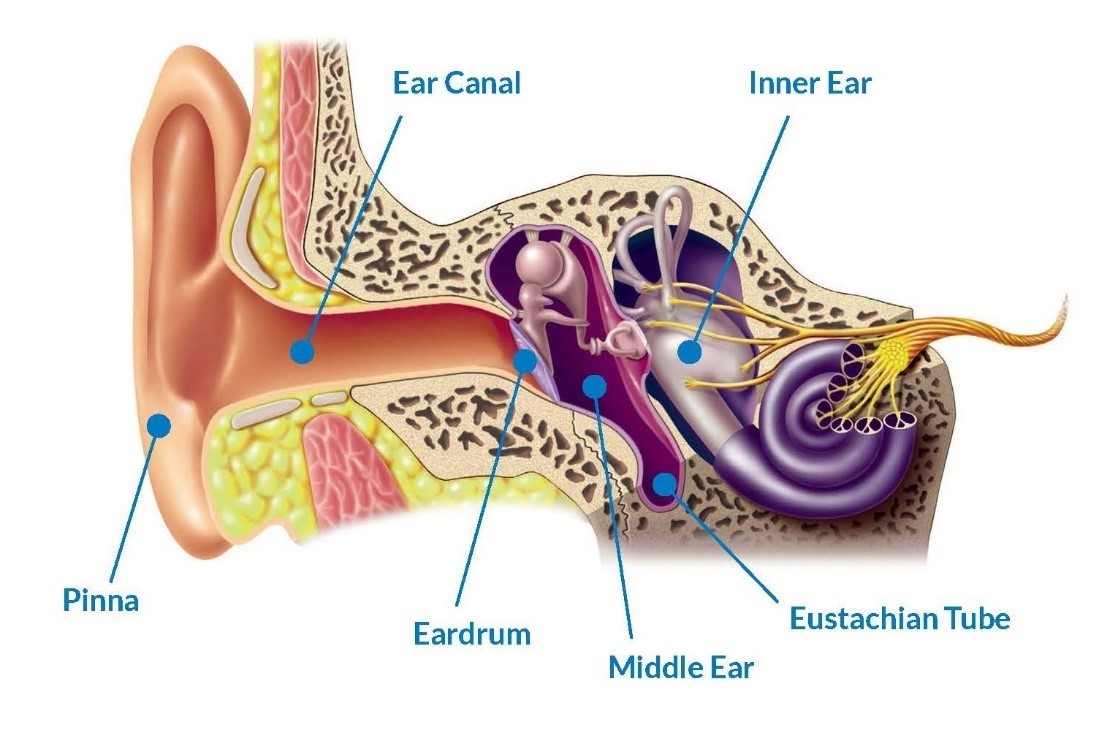
Your ear consists of three main parts: the outer, middle, and inner ear. Sound enters the outer ear and causes vibrations through the middle ear. The inner ear responds to these vibrations and sends a signal along your hearing nerve to the brain.
When your hearing test is ‘normal’ it tells us that the parts of the ear that are collecting sound and sending it to the hearing nerve are working well.
However, this is only a small part of how you hear. Once the sound reaches your hearing nerve, it is sent to your brain where the sounds are converted into words.
When lots of sounds enter the ear, the brain works hard to process these in ‘real time’. Your brain has to not only work out what the sound or word is, but where it is coming from. This ‘processing’ of sounds can be made harder in difficult environments such as background noise, where the brain is also trying to filter out the other sounds and focus on what you are trying to hear.
Then the brain helps us decide how to react to what we have heard. Is someone calling our name? Or is the phone ringing?
This is a very involved process that helps us make sense of the sounds coming from the world around us.
This process is often referred to auditory processing.
What is a normal level of ‘auditory processing’ difficulty?
There is no clear answer to this as there is no real definition of ‘normal’ and just because one person struggles more hearing than another doesn’t mean they are ‘not normal’, just as one person may find it easier to identify smells than another.
Often when we have started to notice something, we then notice it more and more. For example, when you notice an itch, it then comes to the forefront of your attention. Family and friends can inadvertently reinforce this sometimes as well by assuming that mishearing is always “your” problem and not that they have asked a question from another room or when the kettle is on. It can be easy to forget that most people will struggle in those situations.
What could be causing my difficulties in processing sounds?
As you have seen the process of making sense of sound is very complex.
It is possible that you have a disorder with your ear, but there is also the possibility your ears are entirely normal, this can be very difficult to determine.
But it is worth noting that many things can affect our concentration and make it more difficult for our brains to process information. Tiredness, busy lives, being under stress, having physical or mental health problems can have an impact. More than this, the stress and anxiety of worrying about hearing can then make things even worse.
As well as this, anything that makes the sound more difficult to understand in general will have a negative impact. Things like listening in a language that is not your first language or listening when there is a lot of background noise.
Everyone, even those who don’t report any difficulty hearing, will mishear things occasionally and find certain situations more difficult than others.
Other Conditions
You have probably come to see us because you feel your hearing is having a significant impact on your life.
As well as the factors above that affect auditory processing there are some other conditions (that may not include a “typical” hearing loss) that can affect how you process sound.
Normal aging of the brain can affect understanding, as some processes can slow down. This slows the speed at which a person can process speech, so keeping up with conversation will be harder.
If you have a known condition that affects your brain this may also be having an effect (such as brain injury, stroke, or other conditions) however we are not able to give specific information regarding these as these are beyond our area of expertise.
Within an adult audiology clinic, it is very common that people have some factor affecting their ability to process speech, and this increases with age.
Auditory Processing Disorder (APD)
Auditory Processing Disorder (APD) is condition where people have difficulty making sense of both speech and other sounds. People with APD struggle to understand and interpret speech because of the way their brains process sound.
Adults with APD may complain of:
- Difficulty understanding speech with background noise (such as restaurants)
- Difficulty maintaining attention
- Difficulty understanding unfamiliar speakers
- Difficulty following long conversations
- Difficulty locating the source of a sound
- Misinterpreting information
- Feeling exhausted at the end of the day due to straining to follow conversations
However, people without APD can also experience similar problems, so having these difficulties does not necessarily mean you have APD.
APD can also occur with other conditions such as autism, dyslexia, and dyspraxia (which can be called neurodiversity) but this is not always the case.
Can I be tested for APD?
APD is very challenging to diagnose due to the following reasons.
- The typical symptoms of APD overlap with a range of other disorders. This makes it very difficult to determine if the symptoms experienced are related to APD or not.
- Although there are tests available to assess auditory processing abilities, there are no nationally accepted tests that we can use to say someone has APD. However, if an individual does have symptoms of APD we can provide information to try and help.
What can you do to hear better if you have difficulties processing sounds?
Introduction
We understand it may be frustrating to think you have this condition but not able to have it confirmed. However, the information and advice below is both for people who have suspected APD as well as any one experiencing day to day hearing difficulties, even with a ‘normal’ hearing test.
There are no treatments that are specifically funded by the NHS for APD and so having, or not having a diagnosis does not affect whether you would be offered any of the below resources. Some things such as assistive listening devices would need to be purchased privately (or by your employer).
Every person will have very different situations that they find difficult. It may be worth starting by asking yourself what is it specifically that you have difficulty with, and what you would most like to improve. This might help you decide what options below might help you most. For example, if the phone is a particular problem in an open plan office, then looking at solutions for this may help.
We recommend looking at the whole picture of what difficulties you are having including when and where, and so doing a few different things that give a little bit of help can add up to making a bigger difference overall.
Do I need a hearing aid?
Hearing aids work by making sounds louder or amplifying them. The amount of amplification needed is based on the hearing test results. If there is no hearing loss the prescribed amplification would do nothing or almost nothing, and so we do not provide hearing aids when people have a normal hearing test.
Practical suggestions to help you hear
- Try to be within 1 to 2 metres of the person speaking and concentrate on their words.
- Tell people when you cannot hear them.
- Ask for things to be said slower, louder or ask specifically for what you missed, e.g. “What time did you say we are going out?”
- Ask people to “rephrase” something rather than repeat it. Hearing the same concept with different words may help fill in the gaps
- Re-educate friends, family and try not to take their frustration personally.
- Reduce background noise by e.g., turn the TV off to have a conversation, use headphones to listen to the TV or music
- Being aware that situations when there is noise such as doing housework or cooking will be more challenging to hear conversation.
Listening environment
As with reducing background noise, you may find making changes to where you are in a room can help.
- Being in a corner, or at the edge of a room with a wall behind you can help, particularly in open plan places such as a restaurant. (Ask if you can move desks if you work in an open plan office).
- Some soft furnishings can help with background noise.
- Sit at the front, or near the main speaker in meetings or lectures.
- Choose a restaurant with soft furnishings or alcoves
- Sit away from other sounds such as traffic outside, or away from an open window if it is noisy outside, or equipment such as printers at work.
Are there tips for my family and friends to help me hear?
They can:
- Avoid speaking from another room and gain your attention or establish eye contact before talking.
- Ensure that their full face is clearly visible and reduce background noise.
- Not shout but speak clearly and not too fast.
- Make the subject of the conversation as clear as possible e.g., “we’re talking about......”
- Try to use full sentences, rather than short phrases.
- Rephrase the sentence, if not understood. If still not understood, write it down.
- Let you have “switch-off times” during the day, for relaxation, as listening is very tiring.
- Be patient, positive and relaxed.
Is there other equipment which might help me?
There are some devices that may help you hear better. These are not available on the NHS but can be purchased privately. The links in ‘Additional Resources’ below give details about organizations that can advise on where they can be purchased from.
While amplification with hearing aids is not needed you may find it easier to hear if you adjust the volume of your phone, using a speaker phone may also help you as you have the advantage of both ears.
- Headphones may help for TV and phone as they help to cut out some background noise.
- Subtitles on the TV may help you follow a programme.
- Assistive Listening Systems are wireless devices that receive sounds and send the signal to the ear of the listener. These can be useful in meetings or lectures. The speaker wears a small microphone, and you wear a receiver on the ears. These devices help to reduce the effect of distracting noise, allowing better access to what the speaker is saying.
- Apps may also help.
These include voice amplifier apps which may be helpful as you can direct it toward the person you are trying to hear. Also, wearing headphones for this may help block out some background noise.
Speech to text apps can also help by providing real time subtitles in lectures or meetings, or out with friends.
Most of these can be searched for via your mobile phone app store or by looking at this guide.
The RNID website also carries news stories on new app developments.
It is important to remember that these apps are developing all the time, some are better designed than others and some may have regional or language limitations. We recommend doing your own research on what is available and what you think might work best for you.
Listening practice
Just as our bodies can benefit from exercises so can our hearing pathways.
This can be in the form of Auditory training programmes or day to day listening practice. At the present time the NHS does not supply any formal training programs for APD, however there are a number of training programs which can be purchased privately.
These include:
- Listening and Communication Enhancement (LACE)
www.laceonline.co.uk/LACE
A video is on the site explaining the programme. It does mention the effects of aging, please note that this programme is not just for those affected by aging and can be beneficial for people experiencing listening difficulties regardless of age.
We have been able to obtain a discount code of around 40% for our patients.
To use this, click on "get started" at the bottom of the page then select the UK version and enter:
NHSSurrey
(please note the hospital does not receive any payment when our patients use this)
- The Listening Programme
This is a music listening therapy programme designed to improve listening and learning. It involves listening to acoustically-modified instrumental music through headphones to improve focus, self-regulation, learning and memory. It is designed to help with challenges listening in background noise, the need for information or directions to be repeated.
https://www.learning-solutions.co.uk/the-listening-program
Wellbeing
Factors such as tiredness, physical and mental health problems and stress can find this affects their ability to hear.
Focusing on aspects to improve the effects these are having on you can also benefit your hearing ability.
There is a vast array of Wellbeing resources online. The NHS.uk website is a good place to start.
Mindfulness exercises can also be useful, and you may find apps helpful. Again, there are many, the most common being Headspace and Calm, but you will need to do your own research on these as to what you think will work best for you.
Mental Health Support
If you are experiencing mental health issues Mind Matters is the service for those In Surrey aged 17 and over to access talking therapies.
Additional Resources
|
RNID (formerly Action on Hearing Loss) The UK charity supporting deaf people and those with hearing loss and tinnitus. Has a lot of information including leaflets that can be downloaded. They also have a shop to purchase a range of equipment. Tel 0808 808 0123 |
|
Access to Work Providing help and support at work |
|
Sight for Surrey Provide support with information about hearing loss, communication skills training & equipment and technology support https://sightforsurrey.org.uk/ Tel: 01372 377701 |
References
BSA APD Special Interest Group (2018)
An overview of current management of auditory processing disorder (APD), BSA 2018
Contact details
Audiology Department
St Peter’s Hospital
Guildford Road
Chertsey
Surrey, KT16 0PZ
Audiology Department
Ashford Hospital
London Road
Ashford
Middlesex, TW15 3AA
Telephone:
01784 884351 (Appointment Centre)
01784 884156 (Audiology Department)
Email:
Website: https://www.ashfordstpeters.nhs.uk/audiology
Includes service updates, further information, links to forms and the video appointment system.


