

Understanding and Managing Tinnitus: Tinnitus is the sensation of hearing sounds when no external source is present. Commonly described sounds include ringing, buzzing, humming, or whooshing, which may occur in one or both ears or within the head. Tinnitus can be continuous or it can come and go, with varying degrees of loudness. Many people notice it more in quiet settings, such as at night.
Leaflet Details
| Title | Understanding and Managing Tinnitus |
| Department | Audiology |
| Author(s) | A. Lindsay, J Stevens, J Hatton |
| Review Date | February 2026 |
| Next Review | February 2029 |
| Download | A5 Booklet PDF |
| Accessibility Options | Click on the Recite Me button to show our accessibility resources |
Patient Information
What is Tinnitus?
Tinnitus is the sensation of hearing sounds when no external source is present. Commonly described sounds include ringing, buzzing, humming, or whooshing, which may occur in one or both ears or within the head. Tinnitus can be continuous or it can come and go, with varying degrees of loudness. Many people notice it more in quiet settings, such as at night.
There are different types of tinnitus:
- Subjective tinnitus - this is a sound only heard by the individual, this is the most common type of tinnitus.
- Objective tinnitus - this is rare and involves sounds generated by the body, such as blood flow.
- Pulsatile tinnitus - a rhythmic sound, often in sync with the heartbeat.
- Musical tinnitus - Hearing musical notes or fragments of songs, known as musical hallucinations.
Who is Affected by Tinnitus?
Approximately 30% of people will experience tinnitus at some point in their life. About 1 in 7 people will experience persistent tinnitus. Although tinnitus can affect people of any age, it’s more common among older adults and those with hearing loss.
What Causes Tinnitus?
It is not always clear what causes tinnitus and in some cases there will not be a specific explanation for your tinnitus.
However, tinnitus can be caused by things such as:
- Hearing Loss: leading the brain to “fill in” missing sounds.
- Ear Conditions: including earwax build up, ear infections, or a perforated eardrum.
- Other Health Conditions: including head or neck injuries, jaw disorders or cardiovascular disorders.
- Medication Side Effects: Certain drugs can cause or worsen tinnitus.
- Change in stress levels
What can be the Impact of Tinnitus?
For some, tinnitus is mild and easily managed. However, others may find it more bothersome and that it interferes with emotional well-being, sleep, concentration and daily activities.
How can I Reduce the Impact of my Tinnitus?
Tinnitus can be worrying when you are not used to it but try not to focus on the noises or seek a cure as this will heighten your brain’s awareness of the sound.
If you can find a way to perceive your tinnitus differently then your brain will find a way to disregard the tinnitus as an important signal and this will help reduce your awareness of it.
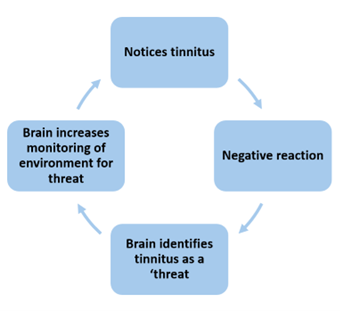
The diagram below shows how we react to tinnitus. You will note that the negative reaction feeds into the brain’s perception of your tinnitus. If we can find a way to stop the negative reaction this breaks the cycle.
What is the Treatment for Tinnitus?
While there is no cure, there are several different treatment options which can help reduce the negative impact of tinnitus and enable you to have a good quality of life despite having tinnitus and make it less distressing and bothersome.
Some of these you can try at home and others are professional support.
Sound Therapy
Using background sounds can help distract from tinnitus. Options include:
- Everyday sounds like a fan, soft music, or nature sounds
- Tinnitus apps which can be downloaded to your smart phone or tablet (see below for details)
Wellbeing
Factors such as tiredness, physical and mental health problems and stress can make tinnitus seem louder or more bothersome.
Focusing on aspects to improve the effects these are having on you can help your tinnitus. There is a vast array of Wellbeing resources online. The NHS.uk website is a good place to start.
Factors such as physical activity and a balanced diet support overall well-being and may indirectly help with tinnitus management. Social activities and hobbies can also help. You may find arts or crafts, or activities like adult colouring books may help to reduce your stress and improve your tinnitus.
Relaxation and Mindfulness
Relaxation techniques may reduce the impact your tinnitus has on you. There are various techniques such as breathing exercise or visualisation. The NHS.uk webpage has information about these.
Mindfulness involves paying attention to the present moment, helping to reduce stress. Regular mindfulness practice can help you accept the tinnitus rather than react negatively to it, promoting calm and relaxation.
Apps such as Headspace and Calm provide guided mindfulness sessions, breathing exercises, and relaxation tools designed to reduce stress and improve mental well-being. These can be especially useful for managing tinnitus and are available for download on most smartphones.
Sleep
Maintaining a regular sleep schedule, creating a relaxing bedtime routine, and limiting stimulants like caffeine can improve sleep and make tinnitus easier to manage. The apps mentioned above also have sections on sleep. Others may find sleep podcasts useful.
The NHS webpage also has information on sleep.
https://www.nhs.uk/conditions/insomnia/
Communication
Talk to family and friends, and consider joining a support group.
Hearing Aids
For those with hearing loss, hearing aids can amplify external sounds, helping to mask tinnitus and improve communication.
Cognitive Behavioural Therapy (CBT)
CBT can help you to manage issues by challenging thought patterns and reactions.
It is used for a range of different conditions.
General information about CBT can be found on the NHS website.
https://www.nhs.uk/tests-and-treatments/cognitive-behavioural-therapy-cbt/
It can be used for tinnitus to manage negative thoughts and adjust unhelpful behaviours.
How can I access CBT for my Tinnitus?
CBT is a talking therapy carried out in a one-to-one appointment but there are also self-help books you can use to teach yourself how to use CBT for tinnitus.
The NHS webpage gives advice about using self-help therapies.
https://www.nhs.uk/tests-and-treatments/talking-therapies/
One to one CBT can be accessed privately.
On the NHS you can be referred to the Royal Surrey Tinnitus Service if your tinnitus:
- affects your ability to carry out day to day tasks and sleep or causes a consistent low mood
And
- on a scale of 1-10 (10 being huge impact) has an impact of 5 or more on your day-to-day life.
This is a clinic run by Audiologists who are trained in CBT techniques and how to use them for tinnitus. This is not a mental health service and you will not be seen by a Psychologist.
Apps to help Manage Tinnitus
There are several apps which you can download to your phone to help manage your tinnitus
- ReSound Tinnitus Relief App: Offers customizable sounds, guided exercises, and relaxation techniques specifically designed for tinnitus management.
- Tinnibot: A virtual assistant app for tinnitus management that provides daily activities, educational resources, mindfulness exercises, and CBT-based activities to help reduce the impact of tinnitus. Part of the app is available for free, but there is a charge for full access.
- Oto App: a tinnitus management app which aims to help patients to manage and habituate through various techniques including mindfulness, CBT and sound therapy.
- MindEar App: combines a series of tinnitus management techniques to provided customized tinnitus care. The app aims to help patients understand their tinnitus and find suitable tools to manage it. There is a subscription cost associated with it
Further Resources and Support
| Tinnitus UK: Provides comprehensive information, support resources, and self-help tools, including helplines, online forums, and tinnitus support groups.
Tel: 0800 018 0527 |
|
Take on Tinnitus: Developed by tinnitus specialists, this free online learning system guides new users through facts about tinnitus and self-help strategies in seven short modules. It’s suitable for anyone experiencing tinnitus. |
|
RNID: This organization offers resources on managing tinnitus and hearing loss, including advice on lifestyle adjustments, support groups, and treatments. Tel: 0808 808 0123 |
|
Mind Matters: Mind Matters Surrey is the local NHS provider offering free and confidential talking therapies to people aged 17+ registered with a Surrey GP. They offer individual therapies, guided self-help online and group courses to help treat a wide range of mental health issues. https://www.mindmattersnhs.co.uk Tel: 0300 330 5450 Text 07786 202565 (8.30am-5.30pm). |
Contact details
If you have any questions please contact us by email, phone or letter:
Telephone:
01784 884351 (Appointment Centre for new appointment enquiries)
01784 884156 (Audiology Department for follow up appointments and general enquiries)
E-mail:
Audiology Department
Ashford Hospital
London Road
Ashford
Middlesex,
TW15 3AA
https://www.ashfordstpeters.nhs.uk/audiology
Includes further information, links to forms and the video appointment system.
This information has been produced collaboratively between Ashford & St Peter’s and the Royal Surrey Audiology Departments


