

Breast Patients Discharged with Redivac Drain: Following surgery to the breast and / or under the arm, a wound drain may be inserted. This helps to prevent fluid from collecting and causing swelling thereby reducing the risk of infection. It also helps in reducing any bruising to the area.
Leaflet Details
| Title | Breast Patients Discharged with Redivac Drain |
| Department | Breast Clinic |
| Author(s) | Regina Santos |
| Review Date | March 2020 |
| Next Review | March 2022 |
| Download | A5 Booklet PDF |
| Accessibility Options | Click on the Recite Me button to show our accessibility resources |
Patient Information
Introduction
Following surgery to the breast and / or under the arm, a wound drain may be inserted. This helps to prevent fluid from collecting and causing swelling thereby reducing the risk of infection. It also helps in reducing any bruising to the area.
The drain is removed when the amount draining is less than 25 mls per 24 hours or after 7 days whichever is sooner. In some situations the drain is left for a longer period of time. The drain is usually removed by the breast care nurses or occasionally we may arrange this to be done through your district nurses.
You will be advised to bring a specific bag in which to keep your drain. This can be attached to your waist with a belt.
Emptying the drain
During your hospital stay, your 24-hour drain output is measured; this is done by putting a mark on the bottle to signify where the level of drainage is. The bottle is calibrated with lines and numbers to make it simple and easy.
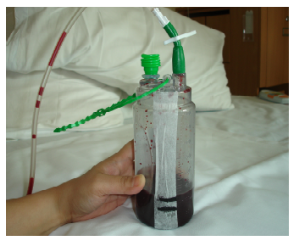
On discharge, you will be advised to measure the drain output at a time that is convenient for you, e.g. every morning. What is important is that the 24-hour output is measured at roughly the same time each day.
You will be provided with a spare drainage bottle. Your nurse will show you how to measure the drainage and how to change the bottle. The drain is removed when the drainage is clear and the output is equal to or less than 25 mls in 24 hours. Your Breast Care Nurse will advise you if the drain needs to stay longer.
There are three reasons why your bottle may need changing at home. These are:
- when the bottle is full
- when the green vacuum indicator is completely expanded indicating no suction left
- if the tubing disconnects
Do not panic
Just follow the steps below to change the bottle. Your nurse will demonstrate this before you go home.
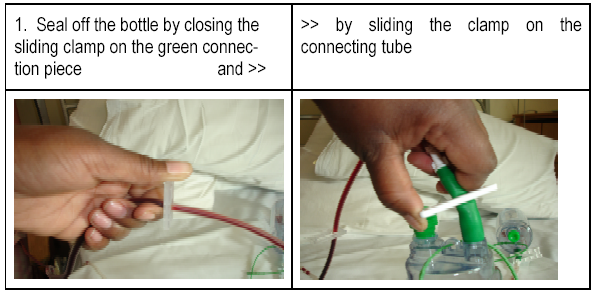
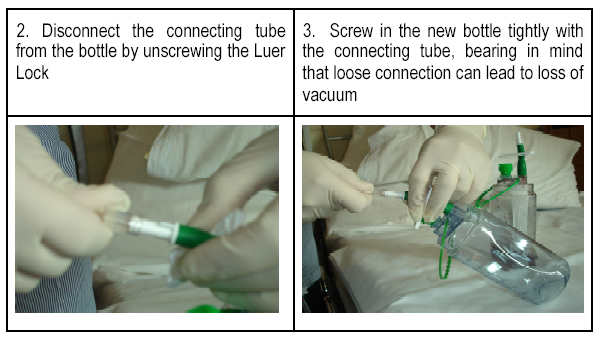
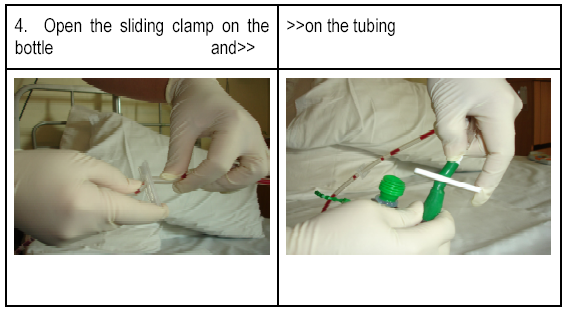
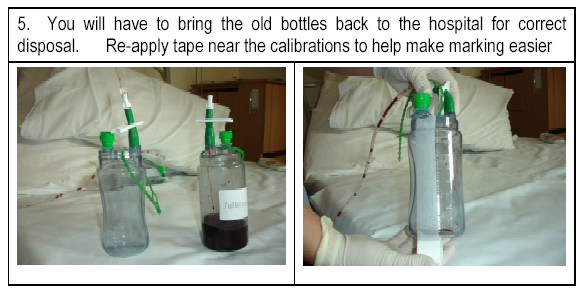
Removal of the Drain
Before you are discharged from hospital, a plan will have been put in place for removal of the drain once the volume of drainage has reduced. This is usually arranged with a breast care nurse or, if appropriate, the ward nurses will make the necessary referral for the District Nurse to visit you at home.
Contact the breast care Nurses if:
- The area around the drain site feels swollen or warm
- The breast / chest or under the arm on the operation site feels swollen or warm
- The drainage tubing has been pulled out so that the holes in the tubing are showing. This may be noticed by you when the green vacuum indicator immediately expands as soon as you change the bottle.
- The amount of fluid draining each day is increasing rather than decreasing
- The fluid suddenly seems to stops draining altogether
Contact Numbers
After discharge, should you have any concerns or queries, please contact the Breast Care Nurses during office hours.
Telephone numbers of Breast Care Nurses are:
- At Ashford Hospital direct 01784 884411
- St. Peter’s Hospital direct 01932 722771
- Via switchboard 01932 872000 bleep 5129
At evenings and weekends direct telephone number of the ward:
- Dickens Ward 01784 884004 / 884574
- Kingfisher Ward 01932 722380 / 722564
Details regarding our hospitals, including information regarding the department caring for you can be found by logging on to our website www.ashfordstpeters.nhs.uk or the National NHS website www.nhs.uk which includes an A to Z guide to health.


