

Leaflet Details
| Title | Insulin Pump Therapy |
| Department | Diabetes |
| Author(s) | Diabetes Team |
| Review Date | March 2020 |
| Next Review | March 2022 |
| Download | A4 Booklet PDF |
| Accessibility Options | Click on the Recite Me button to show our accessibility resources |
Patient Information
Contents
- What is insulin pump therapy?
- Types of pumps
- Pump therapy funding
- Basal rate testing
- Hypoglycaemia (low blood glucose) management
- Hyperglycaemia (high blood glucose) management
- Reverting back to pens/syringes in case of pump failure
- DKA (diabetic ketoacidosis)
- Sick day rules
- Travelling
- Uploading of pump data at home
- Contact Details
1. What is Insulin Pump Therapy?
An insulin pump is a small electronic device which delivers short-acting insulin every few minutes in tiny amounts, 24 hours a day. Insulin flows through a cannula which sits in the subcutaneous tissue and it is changed by the pump user every 2-3 days.
Your insulin doses are separated into:
- Basal rates - This is the small amount of insulin that your insulin pump continuously gives you. Your pre-programmed rate is determined by your own body's requirements. This replaces basal/long acting insulin.
- Bolus doses - To cover carbohydrate in meals / snacks
- Correction doses - To correct high blood glucose levels
2. Types of Pumps
- ‘Tethered’ pump – uses a fine tube to connect the pump to the cannula; the pump is worn in a pocket or clipped to a belt.
- Cannula types available for some pumps:
- Soft cannula - 6mm or 9mm at 90 degrees or 13mm at 45 degrees. These stay in for 2-3 days. There is a risk of these kinking: it is very important blood glucose is tested at least 4 times a day
- Steel cannulas - stay in for 2 days
- Reservoir - all reservoirs, tubing and insulin should be changed every 3 days (these items may last longer but it is often easier to change everything at the same time).
- Patch pump - has no tubing and the pump is stuck straight onto the skin. This needs to be changed every 2-3 days.
3. Pump Therapy Funding
Your pump will be under warranty for 4 years, but it remains the property of your Clinical Commissioning Group (CCG). This is the body that funds your ongoing pump care.
It is important that people on pumps continue to benefit in the long term. The CCG requires an annual update to demonstrate an improvement in the criteria for which insulin pump funding was originally granted. If there is no improvement from baseline, funding will then be withdrawn by the CCG. To avoid this, it is important you continue to communicate and work with your team to achieve and maintain improved diabetes control.
Pump training is provided, as well as ongoing support from your diabetes healthcare team. Pump manufacturers also give technical support via customer helplines.
An insulin pump therapy contract should be signed by the patient and the healthcare professional. Please see Patient Agreement.
4. Basal Rate Testing
- Basal rates should be tested where there is an indication that the background rates are not as close to your body’s requirements as possible.
- Choose days that are as “normal” as possible; no stress, illness, recent hypoglycaemia, alcohol, menstruation or sleep deprivation. Do not exercise for 12 hours prior to the test.
- If the basal programme is correct, glucose should not increase/decrease by >1.5mmol/l in the fasted state.
- Please ensure at least 4 hours have elapsed since you last ate or drank (other than water) before you begin testing.
- If you have to treat blood glucose of over 14mmols or under 4mmols you will have to stop that session of basal rate testing.
- The time blocks are set out in the downloadable leaflet.
5. Hypoglycaemia Management whilst on an Insulin Pump
- Hypoglycaemia = any glucose reading less than 4mmol/l.
- Treat with 15-20g of fast-acting glucose (i.e. 170mls of Lucozade, 150mls of normal Coke, 4-5 glucose tablets, 5 jelly babies, 8-10 jelly beans).
- Re-test at 15 minutes – if blood glucose is still below 4mmol/l then please repeat the above.
- Once your glucose level is above 4mmol/l then no further treatment is needed.
- Patients on pumps do not need a snack following a hypo. If they wish to eat they will then need a bolus dose of insulin to cover the carbohydrate.
- Do not change any settings on the pump whilst glucose levels are less than 4mmol/l.
6. Hyperglycaemia Management whilst on an Insulin Pump
Steps to follow if your blood glucose is 14mmol/l or above:
- Take a correction bolus via the pump.
- Check blood glucose again in 2 hours - if no change or glucose is higher, take a correction injection with a syringe or pen AND check for ketones.
- Change infusion set and reservoir or use a new pod - use a new vial / cartridge of insulin.
- Check glucose and blood ketones again in 2 hours.
- If ketones are positive, follow Sick Day Rules.
- Do not go to sleep with:
- unexplained hyperglycaemia which has not resolved
- or within 2 hours of a new set change
- Once the blood glucose is under 10mmol you should consider the cause of the high reading.
- You must bear in mind that the pump will not factor into its calculations any insulin given via a pen or syringe in the previous 4 hours.
- If you feel there is a problem with the pump, contact the pump company for advice.
- If the pump is not working then the back up for all pump patients is to revert back to pens/syringes. You must always have spare long and short acting insulin (in date) and a method of delivery as a back-up i.e. pens or syringes.
Table 1: Causes of unexplained hyperglycaemia
| Infusion set | Insulin pump | Insulin |
| Is the tubing primed or filled with insulin? | Did you forget your last bolus? | Is your insulin expired / inactive? |
| Is there air in the tubing? | Have you received any recent alarms? | Has your insulin been exposed to extreme temperatures? |
| Did you remember to fill the cannula with insulin after inserting a new set? | Is your cartridge empty? | How long has the insulin been in the cartridge and tubing? |
| Is the tubing connected to the cartridge? | Is the date and time correct? | |
| Has the infusion set been in longer than 2-3 days? | Are your basal rates programmed correctly? |
Other considerations
- Is the set connected to your body?
- Are there any leaks?
- Is there redness or discomfort at the site?
- Is there blood on / at the site?
7. Reverting back to Pens/Syringes in the event of Pump Failure
Short acting insulin
- Continue to use the same insulin-to-carb ratio for food
- In the event of a pump failure where you only have short-acting insulin with you, check glucose levels and take an injection of short acting insulin every 3 hours
Long acting insulin
- Required if the pump is likely to be out of action for over 12 hours
- Calculate the total basal (background) dose (TBD) from your pump
- This will provide a suitable long acting insulin dose if given once per day. If using Levemir, take 50% of TBD (+/- 10% as above) twice per day, 12 hours apart.
The doses of the long acting insulin will need to be reduced prior to restarting the pump when this is possible.
INSULIN DOSES TO USE IN THE EVENT OF A PUMP FAILURE
Please see the instructions given to you by your clinician.
8. Diabetic Ketoacidosis
The insulin pumps only use short-acting insulin. You have no long-acting insulin in your body. If insulin delivery from the pump is interrupted (e.g. pump failure) or stops, your blood glucose can rise rapidly and quickly lead to diabetic ketoacidosis (DKA). This is a medical emergency.
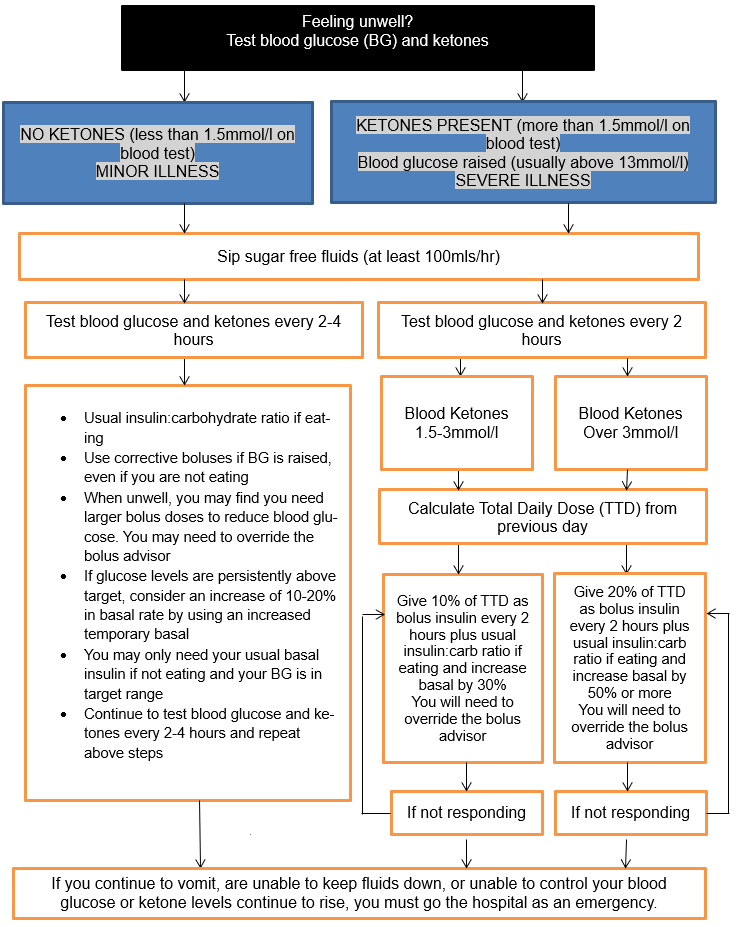
DKA may also occur when you are ill or have an infection- in that case, follow the Sick Day Rules in section 9.
Check your blood ketones with the appropriate meter and strips (if available). If you need emergency attention, ask a friend or family member to take you to the emergency department or call an ambulance. Do not drive yourself.
Symptoms:
- Nausea and vomiting
- Abdominal pain
- Dehydration
- Fruity-smelling breath (“peardrops”)
- Dry skin or tongue
- Drowsiness
- Rapid pulse
- Laboured breathing
- Treatment: follow the advice in section 9 (Sick Day Rules) and liaise with your usual DSN / HCP
- If there is no improvement in your glucose levels and ketones are still present, please attend your local A&E.
9. Sick Day Rules - never stop insulin during illness, even if not eating
10. Travelling
- Please ask for a letter from your diabetes team explaining the carrying of insulin supplies.
- Carry prescriptions for both rapid insulin for your pump and for insulin injections (in case of pump failure).
- Remember the pump is calibrated to use a concentration of insulin known as U100. This is 100 units insulin/100mls; do not use any other concentration.
- Carry bottled water to prevent dehydration.
- If possible, check physician details at your destination prior to travel.
- Pack your pump supplies in carry-on luggage (check with airport security prior to travel for any changes in regulations). Do not pack insulin into hold luggage; it will freeze and no longer be effective.
- Adjust your pump’s clock when crossing time zones.
- The pump / handset can be disconnected but should not be put through the baggage or hand baggage x-ray machine as this could interfere with the pump settings.
- Pumps and handsets cannot go into the new x ray body scanners but can be removed during scanning - check with your pump company as different devices may vary.
Emergency Kit
- Spare pump if supplied by pump company
- Quick acting glucose e.g. jelly babies
- Blood glucose monitoring supplies: meter, strips, lancing device, lancets, batteries
- Insulin
- Back up pens / syringes and a record of required doses
- Ketone testing supplies
- Extra infusion sets
- Batteries
- Pump battery cap
- Pump cartridge cap
- Record of pump settings
- Emergency contact phone numbers
General Advice
- If travelling alone, inform flight staff of your diabetes and ask to be woken for meals
11. Pump Data Downloading
- It is essential to have the right toolkits at home to allow you to download your pump and for your diabetes team to have access to it. This will facilitate offering advice over the phone or via email
- Your healthcare professional/pump company will explain how to download your pump at home
CONTACT DETAILS
- Insulin pump team- please name your pump contact in the subject line
Email:This email address is being protected from spambots. You need JavaScript enabled to view it.
- Diabetes Dietitians
Contact number: 01932 723417
Email:This email address is being protected from spambots. You need JavaScript enabled to view it.
- Diabetes nurses
Contact number: 01932 722844
Email:This email address is being protected from spambots. You need JavaScript enabled to view it.
- For urgent queries, contact the admin team
Contact number 01932 722755
Email:This email address is being protected from spambots. You need JavaScript enabled to view it.
Other useful links
- Driving information: https://www.gov.uk/diabetes-driving
- Information on insulin pump insurance: https://www.diabetes.co.uk/insulin-pump-insurance.html
- ASPH patient leaflets: https://www.ashfordstpeters.nhs.uk/leaflets-diabetes
- Insulin pumps: https://breakthrought1d.org.uk/knowledge-support/


