

Leaflet Details
| Title | Flexible Sigmoidoscopy |
| Department | Endoscopy |
| Author(s) | Robert Cagungao |
| Review Date | October 2026 |
| Next Review | October 2029 |
| Download | A5 Booklet PDF and A4 Handout PDF |
| Accessibility Options | Click on the Recite Me button to show our accessibility resources |
Patient Information
Introduction
This information leaflet contains information about your procedure including the risks, benefits, alternatives to the test and what you might expect when you come to the hospital. If, after you have read it, you have any queries or concerns, please talk to us about any worries and ask any questions you may have.
The aim of this booklet is to enable you to make an informed decision when you come for your procedure. It is important to us that you have understood the procedure, its risks, and benefits before we ask you to sign your consent form. We will need to have your formal written consent before we can perform your procedure.
Your appointment time in the Endoscopy Unit is approximate, as some procedures may take longer than expected. We also deal with emergencies, and these can take priority over patients with outpatient appointments. You should expect to be in the department approximately for most of the morning or afternoon.
Preparation for the procedure
The success of your procedure depends on how clean your colon (bowel) is. To achieve this, you will be asked to have an enema before the test. This is a fluid that is placed in your rectum to clear the last section of your bowel. It needs to be used at least one hour before your examination, and you will usually need to go to the toilet within 15 minutes of using it. You must not eat or drink anything further until after your examination.
We will be sending you the enema together with your appointment letter so you can administer this yourself at home before attending for the appointment. The advantage of this is that this can be done privately in the comfort of your own home.
If you have severe mobility issues or unable to self-administer the enema, this will be given by the nursing staff after your arrival in the unit. You do not need to arrive any earlier than the appointment time we have given you.
If you have severe mobility issues or unable to self-administer the enema, this will be given by the nursing staff after your arrival in the unit. You do not need to arrive any earlier than the appointment time we have given you.
Instructions on how to self-administer enema
Please speak to a member of staff if any of the following applies to you:
- If you have been diagnosed with an inflammatory or ulcerative bowel condition like Crohn’s or Colitis.
- Your doctor has asked you to limit your (sodium) salt intake.
You will need to have the enema at least an hour before leaving home to come for your appointment.
You will need the following:
- Cleen Ready to use Enema®
- Jug or bowl of warm tap water
- Towel
- Bed or couch to lie down
When you are ready to self-administer the enema:
- Place the enema bottle (make sure you keep the lid on) in a jug of warm water for at least 5 minutes.
- Spread the towel on the bed / couch where your bottom will be. Remove the enema from the jug of warm water. Remove the cap from the enema.
- Lie down on your left side with your knees up on your chest (or as much as you can tolerate)
- Gently insert the full length of the nozzle into the back passage and squeeze the contents of the bottle until it is all empty.
- Continue to lie on your left side and try to hold on the enema for as long as you can. When you are no longer able to hold the enema, please sit up slowly and walk to the toilet carefully.
- Place the empty enema bottle in a plastic bag and place it in the bin.
- Please have nothing to eat or drink until after your procedure.
Sometimes, having an enema can make you feel lightheaded. If this happens, sit down, or lie down on the bed / couch until you feel better. You can have some water if would like to.
You may need to go to the toilet more than once after you had the enema. If you find that you still need to use the toilet at the time you plan to come to the Endoscopy Unit, please give us a ring and let us know if you will be delayed for your appointment.
It is quite uncommon to develop serious side effects from the enema, but if you do feel very unwell, please telephone the Endoscopy Unit so we can give you some advice.
Eating and Drinking
You can eat and drink as normal until you have received your enema. Once the enema is given, you must not have anything to eat and drink until after your procedure.
If you wish to have sedation for this procedure, you must not eat anything for at least six hours before your procedure.
You can have few sips of water up to two hours before your procedure.
Medicines
Unless you have been advised otherwise, you should take your usual medicine normally with a few sips of water. Please do remember to bring in the list of your medications.
- Iron tablets - stop taking your iron tablets at least one week prior to your appointment.
- Diabetes - If you are diabetic, please inform the Endoscopy department so that we can schedule your appointment appropriately. If you wish to have sedation for this procedure, please telephone us on 01932 722747 and speak to one of our nurses so we can give you correct advice.
- If you are on any blood thinning medication like Warfarin, Dabigatran, Edoxaban, Apixaban, Rivaroxaban or anti platelet medication like Clopidogrel, Prasugrel and Ticagrelor, please inform us as soon as possible as it may be necessary for you to stop taking your tablets for a limited time before the procedure.
Flexible Sigmoidoscopy
A sigmoidoscopy is a test to examine the lining of your sigmoid colon, this is the lower part of your colon, also called your bowel or large intestine.
This is done using an instrument called an endoscope, which is carefully passed through the anus (back passage) into the large intestine. The endoscope is a long flexible tube, about the thickness of your index finger, with a bright light at its tip. The video camera on the endoscope transmits images of the inside of the bowel to a monitor allowing the Endoscopist to examine the lining of the colon for any disease or abnormalities.
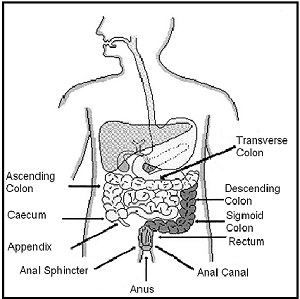
During the examination, tissue samples or biopsies can be taken for analysis. The sample is removed painlessly by a disposable forceps passed down the endoscope. It is also possible to remove polyps during sigmoidoscopy. Polyps are abnormal projections of tissue, rather like a wart, which the Endoscopist will want to remove and examine in more detail. Photographs may also be taken and will be kept in your medical record.
The examination is carried out by a trained doctor or nurse called an Endoscopist. Sometimes, however, the test may be carried out by an Endoscopist who is learning, under the close supervision of the experienced Endoscopist.
Why do I need a flexible sigmoidoscopy?
Your doctor has referred you for this investigation for either of the following reasons:
- To investigate bowel symptoms like alterations in bowel habit or blood in the stool.
- To identify and confirm abnormalities noted in the bowel at other tests like CT scan or barium enema.
- a pre-existing condition such as colitis that needs reviewing
Are there any alternatives?
CT (computerised tomography) scan - This is a special type of X-ray machine that can give more details than normal X-rays. However, it cannot be used to take biopsies or remove polyps, so you may still need a colonoscopy.
Although there are a few alternatives to this test, sigmoidoscopy is the most accurate way to diagnose conditions of the lower part bowel and the only means to obtain tissue samples which might assist with making an accurate diagnosis and treatment like banding or injection of piles.
Will I feel any pain?
Sigmoidoscopy maybe unpleasant and at times uncomfortable due to the air introduced inside your bowel during the procedure; this is normal and will pass quickly. You may also experience pain as the endoscope is negotiated past difficult bends in the bowel.
Sedation via an injection is not routinely given as the procedure is generally well tolerated. But if you feel anxious about the procedure, please inform a member of staff during your pre-assessment and we can organize this for you.
Because the sedation can cause drowsiness, you will not be permitted to drive home or take public transport. You must arrange for a family member or a friend to collect you from the Endoscopy Unit and you must have an adult to stay with you overnight.
There is a considerable variation in the way people react to this procedure and the sedation. The procedure is safe but may be unpleasant and at times uncomfortable. We aim to use the sedation to help you relax within safe limits. We do NOT aim to send you to sleep but we will do our best to make the procedure as comfortable as possible.
As an alternative to sedation, you may wish to consider Entonox® as a pain relief. Entonox is a gas that can help relieve pain. It is inhaled using a mouthpiece; this means you are in control of how little or how much you take. Entonox is quickly expelled from the body, which means you will not need to stay longer in the department. You will also be able to drive home and will not need somebody to stay with you overnight.
What are the possible risks of Flexible Sigmoidoscopy?
Because Sigmoidoscopy is an invasive investigation, it does carry a small risk or complication.
- Perforation: The chance of this happening to you is 1 in 10,000 with a slight increase if you have a polyp removed. This complication rate is based on the national average, and the rate of occurrence of this is well within this figure at Ashford and St. Peter's Hospitals.
If there is a suspicion of a tear, the Endoscopist will organise further tests like x-ray or CT scan. Should these tests confirm that a perforation has occurred, we will arrange for you to stay in hospital to have the right treatment.
- Bleeding: There is also a very small risk of bleeding, either from the site of a biopsy or following polypectomy. In most cases this is trivial and subsides spontaneously, if not it can usually be treated by electrical cautery or other treatment like applying small clips.
Please note that occasionally the test may need to be abandoned or may be incomplete. This can happen if you find the procedure too uncomfortable or if the enema did not empty your bowel completely. In this case, the test may need to be repeated, or we may suggest an alternative procedure.
What will happen when I come in?
When you come to the Department, please present yourself at the reception where they will confirm your details with you. Please note that we have a limited amount of space in the Department and there may not be an available space for a friend or relative to accompany you during your appointment.
A member of staff will bring you in the Admissions area to go through your health questionnaire with you. Your admission nurse will make sure that the procedure is thoroughly explained and that you understand the procedure before you sign your consent form. This will be an opportunity for you to ask any questions you may have. You will be asked to sign your consent form before you can be taken into the procedure room where your endoscopy will be done.
The member of staff will also ask you about your arrangements for getting home after the procedure. If you decided to have sedation, a responsible adult must be available to take you home and stay with you overnight, as the sedation can impair your reflexes and judgment.
| Please note that your procedure will be cancelled if you do not have an escort arranged to collect you from the Department. |
What happens during a Sigmoidoscopy?
Your procedure will be carried out in one of the procedure rooms where experienced members of the team will be always with you. A member of staff will put a blood pressure cuff on your arm and a probe will be placed on your finger to check your oxygen level throughout the procedure, a plastic cannula will also be placed in your nostrils if you requested to have sedation. You will be asked to lie on your left-hand side, if you have requested to have sedation, it will be given at this point.
The Endoscopist will then introduce the endoscope through the anus into the rectum and advance it around the lower colon whilst inspecting the lining for any abnormalities. The entire examination usually takes 15 minutes; but if during the test any abnormality is detected requiring specific treatment given through the endoscope, the procedure might take longer.
Photographs may be taken during your procedure; these will be filed and kept in your medical notes.
What happens after a Sigmoidoscopy?
Following the test, you will be transferred to the recovery area.
If you did not receive any sedation, a member of staff will check your vital signs at least once. If your vital signs are within normal limits and you are not in any discomfort, we will ask you to change back into your clothes. After this, we will ask take to the secondary discharge where we can offer you some refreshments like tea / coffee and biscuits.
If you received Entonox® only, we would keep you in Recovery for at least 30 minutes (and up to 2 hours if a large polyp had been removed) and will monitor your vital signs. After half an hour and your vital signs are within normal limits and you are not in any discomfort, we will ask you to change back into your clothes. After this, we will ask take to the secondary discharge where we can offer you some refreshments like tea / coffee and biscuits.
If you received sedation, you must expect to stay on the Endoscopy Unit for at least 1 hour after your procedure (and up to two hours if you have a polyp removed). Your blood pressure, heart rate and oxygen levels will be monitored to ensure a safe recovery.
If you are diabetic, we may need to check your blood sugar again. Once you are fully awake from the sedative, you will be offered some refreshments like tea / coffee and biscuits. The plastic cannula used to give you the sedation will also be removed. The sedative can make you forgetful and can make you feel intermittently tired and drowsy for at least 24 hours, this is why we strongly recommend that you arrange someone to stay with you overnight. For 24 hours following your sedation, you must not drive, drink alcohol, operate any heavy machinery or sign any legal document. If the person collecting you has left the Department, a member of staff will telephone them when you are ready to go home. Once your escort has arrived, you will be taken to a private room where a member of staff will go through all your discharge information with you.
When you are ready to go home, a member of staff will bring you to a private room where we can explain to you the results of the endoscopy. A copy of your endoscopy report will be given to you.
When will I know the results?
An experienced member of the team will be able to tell you the endoscopy results when you are ready to go home. However, if a biopsy sample was removed, this might take up to six to eight weeks to process (depending on the urgency). We will write to you and GP with the result or arrange an outpatient appointment, whichever is appropriate.
When can I return to work?
If you do not have sedation, you can return to work straight away. If you have sedation, you should be well enough to return to work after 24 hours.
What would it mean if I did not have the flexible sigmoidoscopy?
If you did not have the flexible sigmoidoscopy, your condition would not be accurately diagnosed and, without the right treatment, could get worse.
Can I seek a second opinion?
Yes, if you are not happy with the results, treatment, or advice, you have the right to seek a second opinion, and your doctor can advise you on that tissue if required.
Contacting us
St Peter's Hospital patients - For medical or post-operative enquiries, Endoscopy Admin on 01932 726413 for Endoscopy nurses on 01932 722747. These phones will be answered from Monday to Sunday between the hours of 08.00 and 18.00.
For appointments and general enquiries, call the Endoscopy Booking Office on 01932 726575 between the hours of 0830 to 1630 Monday to Friday.


