

Leaflet Details
| Title | Having a Trans Nasal Endoscopy (TNE) |
| Department | Endoscopy |
| Author(s) | Jean Asare |
| Review Date | February 2026 |
| Next Review | February 2028 |
| Download | A5 Booklet PDF and A4 Handout PDF |
| Accessibility Options | Click on the Recite Me button to show our accessibility resources |
Patient Information
Introduction
This information leaflet contains information about your procedure, including the risks, benefits, alternatives to the test and what you might expect when you come to the hospital. If, after you have read it, you have any queries or concerns, please talk to us about any worries and ask any questions you may have.
The aim of this booklet is to enable you to make an informed decision when you come for your procedure. It is important to us that you have understood the procedure, its risks, and benefits before we ask you to sign your consent form. We will need to have your formal written consent before we can perform your procedure.
Your appointment time in the Endoscopy Unit is approximate, as some procedures may take longer than expected. We also deal with emergencies, and these can take priority over patients with outpatient appointments. You should expect to be in the department for most of the morning or afternoon.
Preparation for the procedure
Eating and Drinking
You must not eat anything for at least six hours before your procedure, as food in your stomach can prevent the Endoscopist from obtaining a clear view of your stomach. It can also increase the risk of inhaling the contents of your stomach into your lungs, which can cause severe pneumonia.
You can have a few sips of water up to two hours before your test.
Medicines
Unless you have been advised otherwise, you should take your usual medicine normally with a few sips of water.
If you have diabetes, either on tablets or Insulin, please telephone us on 01932 722231 / 01932 722747 for advice at least one week before your endoscopy appointment.
If you are on any blood-thinning medication like Warfarin, Dabigatran, Edoxaban, Apixaban, Rivaroxaban or antiplatelet medication like Clopidogrel, Dipyridamole, Prasugrel and Ticagrelor, please inform us as soon as possible, as it may be necessary for you to stop taking your tablets for a limited time before the procedure.
If you are on strong medicine to reduce the acid in the stomach, such as:
- Omeprazole (Losec)
- Esomeprazole (Nexium)
- Lansoprazole (Zoton)
- Pantoprazole (Protium)
- Rabeprazole (Pariet)
Please stop taking this two weeks before your appointment unless specifically advised to continue it by your doctor.
If you are worried that your symptoms will become worse, please contact your GP for advice.
If you have been previously told that you have an ulcer in your gullet, stomach or small bowel and needed a repeat Gastroscopy to check if the ulcer has healed or have been diagnosed with Barrett’s Oesophagus and need surveillance Gastroscopy, you must NOT stop taking the anti-acid medicine you have been prescribed.
What is Tran Nasal Endoscopy (TNE)?
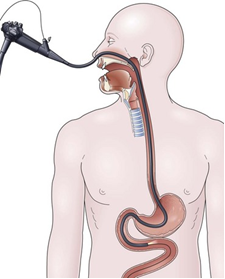
A Trans Nasal Endoscopy (TNE) is an examination that will allow us to look directly at the lining of the oesophagus (the gullet), the stomach and around the first bend of the small intestine or the duodenum. This procedure examines the same part of your body as an oesophago-gastroduodenoscopy (OGD/gastroscopy). The main difference is that the endoscope goes down your nose rather than your throat because it is a thinner tube.
During the procedure, a thin flexible tube (approximately 6mm in width, similar size as a drinking straw) is passed through the nose down at the back of the throat into the oesophagus (gullet), stomach and the first part of your small bowel. Using a slimmer tube has shown to minimise the gagging sensation which commonly occurs when the scope is passed through the mouth; this allows the procedure to be performed with more ease, without sedation. It will not get in the way of your breathing at any time, because it passes down your oesophagus and not your windpipe. You will be able to breathe and talk normally throughout the procedure.
This procedure is usually done with just a local anaesthetic spray, which will be sprayed in your nose and throat before the start of the procedure.
The nasal route is purely used to insert the instrument and is not intended to diagnose any abnormalities or conditions of your nasal passages.
This tube has a light and a camera at the end, which feeds the images into a monitor, allowing the Endoscopist to examine the lining and check for any abnormalities such as inflammation or ulcers.
During the examination, tissue samples or biopsies can be taken for analysis. The sample is removed painlessly by a disposable forceps passed down the endoscope. Photographs may also be taken and will be kept in your medical record.
The examination is carried out by a trained doctor or nurse called an Endoscopist. Sometimes, however, the test may be carried out by an Endoscopist who is learning under the close supervision of the experienced Endoscopist.
This procedure will be done without sedation. If you choose to have sedation instead, it is likely you will be offered an alternative form of endoscopy (standard transoral gastroscopy). In that case, you will not be permitted to drive home or take public transport. You must arrange for a family member or a friend to collect you from the endoscopy unit, and you must have an adult to stay with you overnight. This is because the sedative given for the procedure may remain in your bloodstream for 24 hours and might make you sleepy or forgetful.
There is, however, considerable variation in the way people react to these procedures. Although the procedure is safe, some patients might find it unpleasant and, at times, uncomfortable.
Why do I need a TNE?
You have been advised to have a TNE to find the cause of your symptoms. The results will help your doctor decide on which treatment is best to help you or whether further examinations are needed to be carried out.
A TNE may be advised for several reasons, including recurring indigestion, anaemia, unintentional weight loss, vomiting, bleeding, recurrent heartburn or difficulty in swallowing. It can also be used to check a previously diagnosed gastrointestinal condition, like an ulcer or Barrett’s Oesophagus.
Are there any alternatives?
Transoral oesophagogastroscopy (OGD) / gastroscopy
Alternatively, the procedure can be performed trans-orally (through the mouth) to examine the lining of your gullet, stomach, and small bowel. This procedure can be performed using local anaesthetic medication and sedation. A TNE is more comfortable than a transoral endoscopy because gagging is rare, and you can talk during the procedure to let us know if you are uncomfortable. Because TNE does not involve sedation, you will have a faster recovery time, and you do not need anyone to travel home with you.
If you would still prefer to have this instead of the trans-nasal procedure, please advise the Booking appointment team on 01932 726 575.
Barium meal x-ray
This is an alternative examination. It is not as informative as an endoscopy and samples, or biopsies cannot be taken during a Barium test, so you may still need to have a gastroscopy.
What are the possible risks of Trans Nasal Endoscopy?
Trans Nasal Endoscopy is a safe examination for most people and serious complications are uncommon. The Endoscopy team is trained to detect and treat any complications that may happen. The possible risks are listed below:
- Slight nose or throat pain which usually settles within a few hours.
- Minor nose bleeding, which can occur in 1 in 20 cases, this usually settles simultaneously without needing any treatment. However, a small number (1 in 400 cases) may experience more bleeding, which would require treatment.
- A tear (perforation) in the lining of your oesophagus, stomach, or duodenum. Nationally, this happens to approximately 1 in 10,000 patients. If this occurs, you will need to be admitted to the hospital for further treatment, which may include surgery.
- Bleeding may occur at the site of biopsy; this usually stops on its own. The risk is higher if you are on blood-thinning medications.
- Breathing difficulty or heart irregularities because of a reaction to the medication given before your procedure or accidentally inhaling secretions such as saliva during the procedure. We will monitor you continuously during the procedure, so if any of these problems occur, we will be able to treat them quickly.
- Incomplete procedure. This can happen if you are unable to tolerate the procedure, if there is undigested food in your gullet and stomach or if a complication occurs during your gastroscopy. If this happens, it may be necessary for the Endoscopist to arrange another gastroscopy or an alternative test such as Barium meal.
Are there any reasons why I could not have a TNE?
A TNE may not be suitable if you have the following:
- past broken nose or nasal surgery such as rhinoplasty
- deviated nasal septum
- history of nasal polyps
- known to suffer from recurrent nose bleeds
- allergy to local anaesthetic (lidocaine) spray
- hereditary haemorrhagic telangiectasia (HHT) condition
If you have had any of these, the endoscopist will recommend that you have a transoral (through the mouth) endoscopy instead.
What will happen when I come in?
When you come to the Department, please present yourself at the reception, where they will confirm your details with you. Please note that we have a limited amount of space in the Department and there may not be an available space for a friend or relative to accompany you during your appointment.
A member of staff will bring you in the Admissions area to go through your health questionnaire with you. Your admission nurse will make sure that the procedure is thoroughly explained and that you understand the procedure before you sign your consent form. This will be an opportunity for you to ask any questions you may have.
You will be asked to sign your consent form before you can be taken into the procedure room where your endoscopy will be done.
You will be given a drink containing a medication called simethicone (also known as Infacol, given to small babies to relieve colic) to reduce any bubbles in your stomach to help us get a better view during your endoscopy.
A medication used to clear your nose from mucus and expand the space within your nostrils will be given at least 20 minutes before your procedure, this comes as a spray or drops.
What happens during a TNE?
Your procedure will be carried out in one of the procedure rooms, where experienced members of the team will always be with you.
We will also give you a local anaesthetic spray to numb the upper airways and throat. A spray is applied separately through the nose (to numb and expand the space within your nostrils) and into the back of your throat. This will be given whilst you are sitting up (if you have any dentures, you will be asked to remove them first); the results are rapid, and you will immediately experience loss of sensation at the back of your throat.
You will be able to talk throughout the procedure. You will either be lying on your left side or sitting on a trolley or chair. A member of staff will put a blood pressure cuff on your arm, and a probe will be placed on your finger to check your oxygen level throughout the procedure.
The Endoscopist will start the test by placing the lubricated endoscope into your nose. The Endoscopist will then push the gastroscope gently down into your oesophagus, stomach and duodenum. A small amount of air is blown into your stomach; this is necessary to allow the Endoscopist to have a clear view during the procedure. This air will be removed at the end of the test.
Sometimes a biopsy may be taken for analysis in the laboratory. The tissue is removed using a disposable forceps through the gastroscope; it does not usually cause discomfort, but if it does, this should pass very quickly.
Photographs may be taken during your procedure; these will be filed and kept in your medical notes.
The procedure usually lasts between five to fifteen minutes; the length of the procedure depends on the number of biopsies taken. When the examination is finished, the endoscope will be removed carefully.
Occasionally, it is not possible to pass the camera successfully through the nose. If this happens, the endoscopist will discuss alternative procedures available for you. This may include passing the camera through the mouth, which could be done on the same day under local anaesthesia.
What happens after TNE?
The nurse looking after you will give you all the information about the results of your procedure before you go home. This will also include information on when you can start eating and drinking, and information on what to expect after the procedure. However, if a biopsy sample was removed, this might take up to six to eight weeks to process (depending on the urgency). We will write to you and GP with the result or arrange an outpatient appointment, whichever is appropriate.
Because you did not have sedation for the procedure, you can go home shortly after the procedure.
When can I return to work?
If you are feeling well enough, you can return to work straight away.
Can I seek a second opinion?
Yes, if you are not happy with the results, treatment, or advice, you have the right to seek a second opinion.


