

Leaflet Details
| Title | Coronectomy - Crown Removal |
| Department | Oral and Maxillofacial Surgery |
| Author(s) | Youssef Akoush |
| Review Date | March 2026 |
| Next Review | March 2028 |
| Download | A4 Handout PDF |
| Accessibility Options | Click on the Recite Me button to show our accessibility resources |
Patient Information
What is a coronectomy?
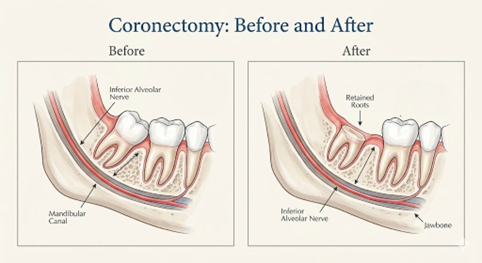
A coronectomy (crown removal) removes just the top part of a lower wisdom tooth (the crown) and leaves the roots in the jaw. We offer this when the tooth root lies very close to the nerve that supplies feeling to your lower lip and chin, because removing the whole tooth could carry a higher risk of nerve injury. The aim is to treat pain or infection while reducing that nerve risk.
Why might I be offered a coronectomy?
You may be offered a coronectomy if:
- The lower wisdom tooth is causing pain or infection
- X-rays show the tooth root is very close to the inferior dental nerve (which supplies feeling to your lower lip and chin)
- removing the whole tooth could carry a high risk of nerve injury.
Alternatives
- Watchful waiting: monitor the tooth with your dentist if symptoms are mild.
- Full extraction: remove the whole tooth (crown and roots) - this may be recommended if the tooth is badly decayed, mobile, or if infection surrounds the root.
What happens during the procedure?
- Local anaesthetic is usually used; sedation or general anaesthesia may be offered in some cases.
- A small cut is made in the gum to expose the tooth.
- A groove is made in the tooth and the crown is removed, leaving the roots.
- The root surface is smoothed and left below the level of the bone.
- The site is closed with dissolvable stitches when needed.
The procedure usually takes about 20-40 minutes depending on the case.
After the operation - what to expect
Possible complications
Most people recover without any serious problems. However, as with any surgical procedure, there are some risks.
Common and temporary effects include pain, swelling and bruising around the site, and stiffness of the jaw.
Less common but important risks include:
- Infection requiring antibiotics or further treatment
- Dry socket (a painful condition if the blood clot is lost)
- Altered feeling in the lower lip or chin due to nerve irritation (usually temporary)
- The roots may become loose during the procedure. If this happens, it may not be possible to leave them safely, and they may need to be removed
In some patients, the remaining roots may move over time and require removal at a later stage. If this happens, the risk to the nerve is often lower.
If you notice increasing pain, heavy bleeding, high temperature, difficulty breathing or swallowing, or loss of feeling that is getting worse, contact the unit or seek urgent care.
Frequently asked questions
Will my root always stay in place?
Most roots remain buried; however, roots can migrate over time in a small number of patients and might require removal later. If that happens, the risk of nerve injury at that later stage is often lower because the root has moved away from the nerve.
Will I have numbness after the operation?
Some temporary numbness can occur because of local anaesthetic or swelling. Permanent numbness is rare but possible.
For further information, please visit the following link:
https://www.baos.org.uk/wp-content/uploads/2022/06/MF12-English-Normal.pdf
This leaflet gives general information only. It does not replace a face-to-face discussion with your surgeon. You will have the opportunity to ask questions and to discuss risks and alternatives before you give consent.


