

Leaflet Details
| Title | Preventing Surgical Wound Infection |
| Department | Surgical Site Infection |
| Author(s) | Anna Thompson |
| Review Date | April 2022 |
| Next Review | January 2023 |
| Download | A5 Booklet PDF |
| Accessibility Options | Click on the Recite Me button to show our accessibility resources |
Patient Information
What is a surgical wound and how do we manage it?
A surgical wound is an intentional cut made into the skin by a surgeon during an operation. At the end of the operation, the cut is closed, and this allows the skin edges to come together and heal. Sometimes stitches(sutures) are used to close your wound, but metal clips or staples may also be used. Sometimes the stitches that are used are underneath your skin so that you cannot see them and other times the sutures will be visible to you. Skin glue, steri – strips or tapes may also be used, either alone or in combination with sutures. A dressing may be applied on top of that.
The skin edges usually form a seal within a day or two of the operation. For some patients this can take longer and can vary depending on the operation performed. In some situations, it is best for a surgical wound to remain open (not stitched) and it heals from the base of the wound up. If this is the plan for your wound, you will receive specific information from your surgical, nursing and or midwifery team prior to being discharged home.
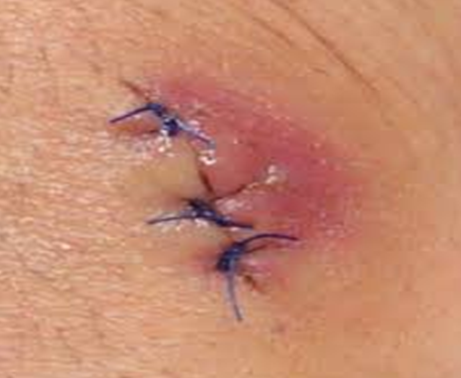
Early signs are redness and swelling around the wound. Warm to touch, pain with / or without yellow / green discharge
How will my wound be dressed?
Not all surgical wounds need dressings. The purpose of a dressing when applied is to:
- Absorb any leakage from the wound
- Provide ideal conditions for healing
- Protect the area until the wound is healed
- Prevent stitches or clips catching on clothing.
Should your wound require ongoing dressings when you are discharged home, the ward will give you a limited supply of dressings to take with you. If needed, you can then obtain more dressings from either your GP, District Nurse, Midwife, or local pharmacy. If you have skin glue, your nurse will inform you. Although the glue is waterproof, try to keep the wound dry for about 5 days. The glue usually peels off in 5-10 days.
Will my stitches or clips need removal?
Most types of stitches, clips or staples must be removed by a nurse or doctor, but some stitches don't need to be removed because they dissolve. If you are told you need to have stitches removed, the nurse and/or midwife will give you a letter for your practice nurse and you will need to arrange an appointment for your practise nurse to do this. If you are house bound the nurse or midwife will arrange for a community nurse / midwife for a visit to your home. In some cases, special skin glue can be used on its own or in combination with stitches.
Although the glue is waterproof, try to keep the wound dry for about 5 days. The glue usually peels off in 5 - 10 days in any case.
What is a surgical wound infection?
Most wounds heal without any problems. The most common complication after surgery is a wound infection. Our skin is a protective barrier and natural defence. There are many bacteria (germs) living on our skin and most of them are harmless but a few and they can cause infection by entering the surgical cut made in your skin. They are very rare and usually only affects the skin but can sometimes spread deeper into the body. Wound infections are usually treated by dressing the wound regularly and you may need a course of antibiotics as well. Sometimes further surgery is required. Some people are more likely to develop wound infections than others and your doctors will discuss this with you.
Who is at higher risk of a wound infection?
You are more likely to develop a wound infection if you are diabetic, smoke , take certain medication which can affect your immune system like steroids and chemotherapy, are poorly nourished (have a poor diet), have been in hospital for a long time before your operation or have had a blood transfusion before your operation. Your surgeon will talk to you about things you can do before your surgery to decrease your risk of infection.
When do these infections develop?
A surgical wound infection can develop at any time from two to three days after surgery until the wound has healed (usually two to three weeks after the operation). Very occasionally, when an implant has been inserted, an infection can occur several months after the operation.
Most surgical wound infections are limited to the skin, but they can occasionally spread to deeper tissues. Infections are more likely to occur after surgery on parts of the body that harbour lots of germs, such as the gut.
How will we monitor your wound?
During your stay in hospital, your nurse who changes your wound dressings will check for any signs of infection. If you are concerned about your wound, tell the nurse who is looking after you.
Don’t be tempted to remove your dressing or touch your wound or wound drain as you could accidentally transfer germs from your fingers to your wound.
Infection can develop after you leave hospital. Some redness and swelling is to be expected after surgery. However, you may have an infection if you develop one or more of the following symptoms:
- The skin around your wound is red or sore or hot and swollen and you do not think that it is part of the normal wound healing process.
- Your wound has a green or yellow coloured discharge (pus).
- You feel generally unwell or feverish, or you have a temperature.
If you have a problem with your wound, contact your GP unless you have been told to contact the hospital.
About one month after your operation the hospital may send you a questionnaire or telephone you to ask if you have any problems with your wound. Many patients leave hospital shortly after their operation and hospital staff need to find out about wound infections that occur after patients leave hospital, as well as those that develop whilst patients are in hospital.
What happens if you develop symptoms?
If the nurse, midwife, or doctor suspects that you have a surgical wound infection, they may swab your wound with a swab and send it to the laboratory for tests. You may be prescribed antibiotics.
What is the Hospital doing to minimise your risk of infection?
To help reduce the risk of your wound getting infected, we have the following measures in place.
- For certain procedures, you will have to be swabbed to detect if you have MRSA, if so, you will be treated before your surgery.
- You will be asked to have a bath or shower on the day of your operation, (if possible) to make sure your skin is clean. For certain surgeries you may be asked to use a specific body wash that will be given to you at pre assessment.
- You may be prescribed antibiotics before the operation to reduce the risk of developing an infection.
- If your operation is planned to take longer than an hour, we will start to warm you up on the ward, before going to theatre, using heated blankets. We will also be keeping you warm while in theatre undergoing your procedure.
- We will monitor your temperature very carefully during your surgery, and we will keep you warm throughout the procedure and in the recovery area.
- If your skin needs to be shaved before an operation, staff will use electric clippers with a disposable head. Do not try to shave the area yourself prior to your procedure.
- Your skin will be cleaned with an antiseptic solution in the operating theatre before the incision is made.
- Staff wash their hands in a specific surgical way before every procedure, wear sterile gowns and gloves and use sterile equipment.
- At the end of the procedure, your wound may be covered with a dressing which should be left in place for at least 48 hours. For some procedures, your dressing might have to stay on for 7 days.
- Our staff are trained on how to change dressings in a way not to contaminate wounds.
All of our doctors and nurses will do everything that they can to prevent your wound from becoming infected whilst you are in hospital.
How do I prevent wound infections?
Take care of your dressing - providing it is not oozing, the original dressing should be left in place as advised by your nurse, midwife, or doctor) If the dressing becomes wet from blood or any other liquid, it must be changed.
Some special dressings that must be kept closed for up to 7 days, and you will receive an information leaflet should you have one of these dressings.
If wound assessments at home are necessary, we will give you information on how to continue to look after your wound until it heals.
How to remove or change the dressing:
- Wash your hands with soap and water.
- Carefully take the dirty dressing off. DO NOT touch the healing wound with your fingers.
- If the wound is healing it can be left without a dressing. Some people prefer to have a dressing to cover the wound for protection, especially when in a position where clothing can rub against it.
- If you still have stitches present and need to change the dressing, open a clean dressing packet taking care not to touch the inside of the dressing so that it remains clean. Gently apply the dressing over the wound. There is no need for antiseptic cream under the dressing.
Of course, you can always contact the GP, practice nurse and / or district nurse / midwife for assistance with managing your dressings.
Stitches (sutures) - dissolvable stitches usually disappear in 7 to 10 days. Other stitches need to be removed after 5 to 21 days, depending on the operation. The doctor/nurse will tell you on the day of discharge when to have the stitches removed. You will be given a letter for your practice nurse about removal. You may see nylon threads (the ends of the stitches) poking out of the healing scar, please do not pull on these. If you are worried about the stitches or they cause you pain or discomfort, seek advice from your GP. Otherwise wait for the stitches to be removed or for them to fall out or dissolve.
Some general points to keep in mind
Bathing and showering You are normally advised to wait 24 hours before showering, but this depends on the operation you have had. The nurses and/or midwives will inform you at discharge when you can safely shower or bath.
Showering is preferable to bathing, and you should only take a bath if you are sure, you can keep the wound dry. Soaking the wound might soften the scar tissue and re-open the wound. Salt baths are not needed.
- Some waterproof dressing can be left in place whilst you take a bath or shower. Other dressings may need to be removed before having a bath or shower. Your nurse / midwife will advise you which dressing type you have prior to discharge.
- Do not put any soap, shower gel, body lotion, talcum powder or other bathing products directly onto the healing wound.
- Do not worry if you splash the wound but do not rub the wound area as this will cause pain and might delay the healing process.
- Pat the wound gently with a clean towel after bathing or showering.
- If the surgery was performed on your face, please do not wear make-up over the scar until it has fully healed.
What information do we pass on?
The hospital passes information about your operation to Public Health England (PHE), which is co-ordinating the national programme for monitoring surgical site infection. The information is related to the risk of developing surgical wound infection. The risk depends on many factors, and includes the following:
- Your sex and age.
- Your general medical condition before the operation.
- The type of operation.
- How long the operation lasted.
PHE treats all patient information as strictly confidential. No data which could be used to identify individuals is published.
What happens to the information?
PHE collects information from over 300 NHS and private hospitals in England taking part in the national programme. The information is used to calculate rates of surgical wound infection for different types of operations. Hospitals can then compare their rates to national rates in order to pinpoint areas to make improvements so that the highest possible standard of care is received by patients.
Patients are able to refuse to allow their data to be submitted for non-care purposes such as research and development by registering with the national data opt out register.
However, in the case of surgical site infection surveillance, this does not apply since data for the purpose of monitoring and control of hospital acquired infections are of a public health risk and therefor exempt.
Contact Us
For all Breast Surgery patients please contact the Breast Care Nurses Team at:
- 01784 884411 / 01932 722771 or 01932 872000
For all Orthopaedic patients please contact the Rowley Bristow Unit at:
- 01932 722730
Or use the contact information that have been given to you by the ward at discharge.
For all Urology patients, if you have any urinary tract symptoms or wound infections, please contact the Urology center:
- 01932 722033
For Colorectal patients:
- Advanced Colorectal Nurse Practitioner: 0790894612
If it is urgent, please contact your GP or go to A&E or your nearest Walk-in centre.
More Information
You can find out more about surgical wound infections in the Guideline on the Prevention and Treatment of Surgical Site Infections published by the National Institute for Health and Care Excellence.
This can be found online at: https://www.nice.org.uk/
If you have any further questions you can contact:
Anna Thompson
Surgical Site Infection Surveillance Nurse
Information provided by Public Health England.


