

Leaflet Details
| Title | Ectopic Pregnancy |
| Department | Early Pregnancy Unit / Women’s Health |
| Author(s) | Dr Olakite Bolaji, Miss N.Izuwah-Njoku, Miss D. Warren |
| Review Date | June 2026 |
| Next Review | June 2028 |
| Download | A5 Booklet PDF |
| Accessibility Options | Click on the Recite Me button to show our accessibility resources |
Patient Information
Introduction
We are sorry that you have been diagnosed with an ectopic pregnancy. We hope that this leaflet will help you understand what an ectopic pregnancy is and your options for treatment.
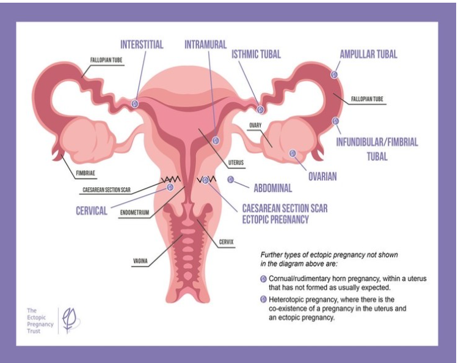
(Image: The Ectopic Pregnancy Trust)
What is an ectopic pregnancy?
An ectopic pregnancy is a pregnancy that develops outside the lining (endometrium) of the womb (uterus). Most ectopic pregnancies occur in the fallopian tube.
How does an ectopic pregnancy form?
In pregnancy the egg and the sperm meet up (fertilize) in one of the fallopian tubes. The fertilized egg then travels down (it is wafted down by tiny hairs) into the womb where it implants (burrows) inside the lining of the womb. Normally, the thick muscle of the womb allows implantation to take place safely without any problems.
In an ectopic pregnancy this journey of the fertilized egg is slowed or interrupted, and it implants outside the womb.
When implantation occurs outside the womb, e.g. in the tube, as the pregnancy gets bigger, it stretches the thin fallopian tube which may rupture (burst) causing internal bleeding. If internal bleeding happens inside the abdomen (tummy), it may be seen on a scan (depending on the amount) or during an operation to treat an ectopic pregnancy. If the internal bleeding is very heavy, this can make you extremely unwell and could occasionally be life threatening.
There are rarer implantation sites for an ectopic pregnancy e.g., interstitial (where the tube meets the womb), Caesarean section scar, ovarian (ovary) or cervical (neck of the womb) ectopic pregnancies and the implications and management will be carefully explained to you.
Sadly, an ectopic pregnancy cannot progress to a normal pregnancy. We are also unable to move the pregnancy from outside the womb to inside your womb.
What are the causes of ectopic pregnancy?
In a normal pregnancy the fertilised egg takes 4-5 days to travel down the fallopian tube and implantation in the womb is usually on day 6-7 post fertilization. With an ectopic pregnancy there are factors which may affect this natural process such as:
- Infection or inflammation of the tube
- Previous ectopic pregnancy
- Endometriosis if it involves the tubes
- Scar tissue on the tubes e.g., from previous tubal or abdominal surgery or severe appendicitis
- Hormonal treatment such as the Progesterone only pill may slow down the motion of the tiny hairs that waft the fertilized egg down the tube
- If you are pregnant with a coil, the pregnancy is more likely to be an ectopic pregnancy. A coil is designed to prevent an intra-uterine pregnancy but can’t prevent an ectopic pregnancy because the pregnancy is outside the womb.
- Smoking may slow the movement of the fertilized egg down the tube.
- In many cases the cause of the ectopic pregnancy is unknown or unexplained.
What are the treatment options?
The treatment options vary, and you will be fully involved in the decision. We will explain the benefits and disadvantages of each option and agree with you on what treatment may be most suitable for your individual case.
Some ectopic pregnancies stop developing and are gradually absorbed back into the body.
Occasionally, the ectopic pregnancy is pushed out from the end of the tube into the abdomen, and it is reabsorbed. This is known as tubal miscarriage. This may be accompanied by abdominal pain and vaginal bleeding. It can be difficult to diagnose a tubal miscarriage on scan alone because the USS features are nonspecific.
In some cases of ectopic pregnancies, treatment with an injection called Methotrexate may be an option. Please refer to the leaflet on treatment of Ectopic pregnancy with Methotrexate.
Depending on your symptoms, the findings on USS, the pregnancy hormone levels, your previous history and you preference, you may not be suitable for treatment with any of the options above and surgical treatment is required. The aim of surgery is to remove the ectopic pregnancy to prevent this from rupturing. A ruptured ectopic may cause internal bleeding that could make you very unwell.
This leaflet is aimed at giving you more information on the conservative and surgical treatment of an ectopic pregnancy. We will discuss mainly the treatment for tubal ectopic pregnancies, the most common type of ectopic pregnancy. Please refer to the separate leaflet treatment for ectopic pregnancy with Methotrexate.
Surgical management
Depending on your clinical assessment, your doctor may advise that surgery is the best treatment for you. In most people it is a relatively quick and safe method of treatment. Studies show that it is effective and the chance of having a successful pregnancy in the future is not adversely affected by choosing this treatment over other options.
The operation is usually done by laparoscopic (keyhole) surgery under general anesthetic, with 2-3 small incisions (cuts) into the abdomen where the camera and instruments are introduced to diagnose and remove the ectopic pregnancy. This will require admission to hospital and an overnight stay may be necessary.
Rarely, keyhole surgery may not be appropriate and an open surgery through a cut along the bikini line is required. This might be because you are too unwell or technical issues with performing the keyhole surgery e.g., previous complex abdominal surgery or being overweight.
The surgeon will look at the fallopian tubes and all the other internal female (pelvic) organs to see if a cause for the ectopic pregnancy can be identified. The surgeon will inspect the other tube if present to ascertain how best to treat the ectopic pregnancy.
Depending on the agreed surgical treatment, the operation findings, the RCOG recommended treatment, the surgeon will either remove the tube with the ectopic pregnancy (salpingectomy) or, if there is only one tube or the other tube looks damaged, the surgeon will try to remove the ectopic pregnancy only and leave the tube (salpingostomy) if possible. Please be aware it may not always be possible to perform a salpingostomy e.g., the tube continues to bleed after removing the ectopic pregnancy or the tube is grossly damaged. If a salpingostomy is performed, there is a risk some pregnancy tissue may remain in the tube. After salpingostomy, you will be advised to attend weekly blood tests to ensure your pregnancy hormone level drops to the non- pregnant level. It is essential you attend these blood tests because we can’t be certain the treatment has been successful until the pregnancy hormone is no longer detectable in the blood stream.
Rarely, after a salpingostomy, residual pregnancy may not resolve fully, and additional treatment may be required. This may be treated with Methotrexate or repeat surgery, rarely. There is a slightly higher risk of a future tubal pregnancy after a salpingostomy when compared to a salpingectomy.
Post-Operative Recovery
If you are Rhesus negative, we will give Anti D. Following surgery, you may have abdominal discomfort for 1-2 weeks because of the cuts we use for the surgery and the gas introduced into your abdomen at the time of the surgery commonly causes shoulder tip pain. This can be treated with pain relief. You may require an injection to thin the blood down to reduce the risk of thrombosis. Please refer to our recovery after laparoscopy leaflet which can be assessed on: https://www.ashfordstpeters.nhs.uk/early-pregnancy-unit
You should expect vaginal bleeding for up to 2 weeks which may be heavier than a period as the lining of the womb is shed.
If you have signs of infection (e.g., fever) you should seek early medical advice (usually via your GP), 111 or attend A & E if you are acutely unwell.
Conservative management
If you are well and don’t have significant pain and meet other eligibility criteria, you may be offered conservative management. This is when we allow the body to absorb the pregnancy tissue without giving any medication. You will be monitored closely as an outpatient in the Early Pregnancy Unit with weekly blood tests until the pregnancy hormone returns to non-pregnant level. This may take several weeks.
You will be advised to stay in the local area and avoid sexual intercourse or strenuous activity. You should attend the Accident and Emergency department (with your report if available) immediately if you develop worsening abdominal pain, feel dizzy / faint or become acutely unwell.
Medical management
In some cases, an ectopic pregnancy can be treated with a medication called Methotrexate. Please refer to the separate leaflet on the use of Methotrexate for treatment of ectopic pregnancy.
Follow up
You will be offered a telephone follow-up appointment in the Post ectopic clinic (usually 6-8 weeks after discharge, depending on availability) to discuss your treatment and implications of the diagnosis for your future fertility. If we haven’t offered you a follow up and would like to arrange a post ectopic consultation, please contact the early pregnancy unit 6-8 weeks after being discharged.
Wellbeing support
Early pregnancy loss can affect your psychological and mental health. Our team of nurses will aim to offer well-being phone call on request. Please let us know if you will like us to support you this way. Your GP should also be able to support you and refer you for psychological therapy or treatment. We can also refer you for counselling or for psychological therapy if you want us to. Please let us know how best to support you and your partner.
Future Pregnancies
In any future pregnancy, you can self-refer to any early pregnancy unit. You can call our unit on 01932 722662 after a positive pregnancy test so we can arrange a scan at 5-6 weeks. We will arrange an earlier scan if you have pain and/or vaginal bleeding. The early scan is to check for the location of the pregnancy because your chance of having another ectopic pregnancy is increased after a previous ectopic pregnancy.
We would recommend you optimize your health e.g., lose weight, if necessary, stop smoking, avoid alcohol, avoid caffeinated drinks, control any health conditions such as Diabetes prior to getting pregnant. Take pre-conceptual Folic Acid 400 micrograms and continue this until 12 weeks. A higher dose of Folic Acid (5mg) will be required in certain women with additional risk factors e.g., raised body mass index (BMI).
If you do not want to get pregnant speak to your doctor or family planning clinic about contraception.
WHO DO I CONTACT FOR MORE INFORMATION?
Staff in the Early Pregnancy Unit (EPU) will be able to answer any further questions you may have.
If you have increased pain at any time, you should contact either EPU or Accident and Emergency as soon as possible.
Early Pregnancy Unit telephone - 01932 722662 Monday - Friday from 09.00 - 1700
Out of hours / weekends / Bank holidays - Please attend Accident and Emergency department for review by the on-call Gynaecology team.
Useful Contacts
Early Pregnancy Unit website
https://www.ashfordstpeters.nhs.uk/early-pregnancy-unit
The Ectopic Pregnancy Trust
https://ectopic.org.uk/
Miscarriage UK
https://www.miscarriageuk.org/
Royal College of Obstetricians and Gynaecologists
https://www.rcog.org.uk/


