Leaflet Details
| Title | How to Recover from an Abdominal Myomectomy |
| Department | Gynaecology |
| Author(s) | Dr Alka Sobti, Miss Ngozi Izuwah-Njoku |
| Review Date | March 2025 |
| Next Review | March 2028 |
| Download | A5 Booklet PDF |
| Accessibility Options | Click on the Recite Me button to show our accessibility resources |
Patient Information
Contents
- Introduction
- Abdominal Myomectomy
- What are the benefits of surgery?
- What are my options?
- Risks and complications
- Before your operation
- Your operation
- After the operation
- Recovery at home
Introduction
This leaflet is for Women’s health and women may be used in parts of this leaflet. We understand some people who don’t identify as women may require to use this leaflet. Your treatment should be personalised, inclusive and sensitive to your needs.
This information leaflet is for those who have or are about to have an abdominal myomectomy. This is an operation to remove fibroids located in the womb either through an incision on the lower abdomen (bikini line) or an incision in the midline which may stop at the umbilicus (belly button) or go above the umbilicus depending on how big the fibroids are. We look forward to welcoming you to Ashford and St Peter’s Hospitals for your operation.
Our aim is for you to come into hospital as healthy as possible, ready for your surgery, and to make a quick recovery. To achieve this, we have created this booklet to provide information on how to prepare and recover from your operation. Everyone recovers differently and the speed of recovery may depend on how complex the operation was, how fit you are, the reason for the operation and if there were any complications during the operation.
Together, we will use the various steps listed below to help you achieve the best recovery.
The key steps that can aid your recovery include:
- Being in good health and ensuring any medical conditions are well managed e.g. diabetes, raised blood pressure etc. beforehand, especially if your operation is pre-planned.
- Eat a healthy and balanced diet
- Stop smoking as this delays your healing and increases the risk of chest and wound infection
- Having good pain relief following your operation
- Being able to get out of bed and move around with/without assistance soon after your operation.
- Getting back to the comfort of your own home as soon as possible.
- Having a positive outlook and attitude
- Keeping your weight within a healthy range (increased weight increases the risk of infection, delays your recovery and increases the risk of clots)
- Regular exercise
Abdominal Myomectomy
What is an abdominal myomectomy?
Myomectomy is a surgical procedure to remove fibroids, via the abdomen, without removing the womb (uterus). This may also be called an open myomectomy.
Fibroids are non-cancerous ball-like swellings in the wall of your uterus (womb). They are created from an overgrowth of muscle fibres. You may have one or more fibroids. They are common, forming in 30-40% of all women. Most fibroids do not cause problems and do not require treatment. They are benign but can sometimes be troublesome.
Fibroids can be:
- Serosal - just under the outside surface of the uterus
- Intra-mural - within the muscle wall of the uterus
- Submucous - just under the inside surface of the uterus
- Some people may have a mixture of these types of fibroids
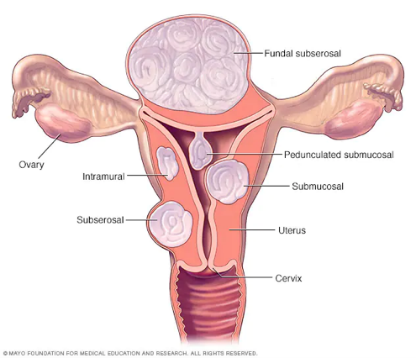
Your doctor can usually feel fibroids that are large enough to cause symptoms when doing a routine pelvic exam.
The operation is usually done either through a cut in your abdomen (tummy) or laparoscopically (keyhole surgery) under a general anaesthetic, where you will be asleep. The choice about which treatment is best for you will be made together with your doctor. This will be based on the risks and benefits of the treatment and individual circumstances.
Why do I need an abdominal myomectomy?
You have been offered an abdominal myomectomy because conservative or medical treatment of your problem has failed or is unsuitable. Your fibroids may be too large or the location of them may be too complex to be removed laparoscopically or vaginally.
Abdominal myomectomy is most commonly used in the treatment of:
- Menorrhagia (heavy bleeding)
- Fibroids causing pain or pressure symptoms, including pelvic pain, back pain and pressure on the bladder causing urinary symptoms.
- Fibroids that may be making the lining of the womb irregular and may impact fertility or rarely result in preterm delivery or recurrent miscarriage
Alternative treatments
You may have tried the following treatments before being recommended surgery or they may not be suitable for you depending on your history, the type, size and number of fibroids and the location.
- Drugs that reduce bleeding only: anti-inflammatory drugs (Mefanemic acid) ad/or tranexamic acid. These treatments will not shrink the fibroids.
- Hormonal treatment may include combined hormonal contraception, the progestogen only methods like the Mirena coil or cyclical progestogens. These treatments don’t affect the size of the fibroid but may reduce heavy menstrual bleeding and can also provide contraception.
- Drugs that shrink the fibroids and reduce bleeding: Ryeqo which contains relugolix, estradiol, norethisterone acetate, Ulirpistal acetate (restricted use due to the possible risk of liver damage) and GnRH agonists. The fibroids may grow back once treatment is complete.
- Uterine artery embolisation, is an image guided, minimally invasive procedure used to reduce the bloody supply of fibroids causing them to shrink. Not all fibroids are suitable for uterine artery embolisation. Though this treatment may be offered in people of childbearing age, detailed counselling about this procedure and impact on pregnancy will need to be discussed carefully.
- Endometrial ablation involves ablating (using radiofrequency waves or other techniques) to destroy the top layer of the lining of the womb to reduce heavy periods. This may be suitable for small fibroids located near the inner surface of the uterus or intra-mural fibroids if the cavity is regular. This treatment is only suitable in people who don’t want to have children in the future. Following treatment, effective contraception will be required.
- Hysterectomy: the womb is surgically removed. You cannot have further children after this treatment.
What are the benefits of surgery?
Surgery may decrease symptoms of heavy periods, pain and pressure symptoms. Removing the fibroid will make your uterus smaller in size and as close to normal as possible and for those with large fibroids, you may no longer feel a lump (enlarged fibroid) anymore. It will reduce the surface area of your endometrium (lining of womb) and so help reduce heavy bleeding.
The impact of myomectomy on fertility, reducing the risk of miscarriage and preterm labour is controversial with some studies suggesting an improvement but others not confirming this. This may be because fibroids may be located in different parts of the womb and their size differs and there may be other reasons for infertility, miscarriage or preterm birth that may not be fully explained by the fibroids alone.
What are my options?
In some cases, there may be no practical alternative to surgery, but alternatives will depend on why an abdominal myomectomy has been advised and will be discussed with you.
The reasons for an open abdominal procedure as opposed to a laparoscopic (keyhole) or vaginal approach will also be explained by your surgeon.
Risks and complications
Whilst every effort will be taken to ensure your wellbeing, no surgery is without its risks there are some risks associated with this particular kind of surgery.
Pain
It is quite normal to experience pain or discomfort, but this can be effectively controlled with painkillers. These will be offered on a regular basis, but please let the nurse or doctor know if your pain is not adequately controlled.
Some women may have painkillers administered through a small pump attached to the arm or hand. A ‘patient-controlled analgesia’ (PCA) allows you to release painkillers directly into the bloodstream. The machine is set so you can only get a safe dose.
Painkillers can also be administered through an epidural immediately after surgery, but this is not commonly used. This is a small tube inserted into the space just outside the membranes surrounding your spinal cord in your back. The anaesthetist may site a spinal anaesthetic (pain killer inserted through the lower spine to numb the pain fibres) immediately before a general anaesthetic for your surgery to provide pain relief for a few hours after surgery allowing enough time for your other oral pain killers to be effective. The anaesthetist will discuss this with you.
Bleeding
This can occur during or after surgery and a blood transfusion may be required. For most myomectomies, we use a cell salvage machine which filters the blood collected during your operation which is returned to you through your vein. This is safe and helps to reduce the need for blood transfusion.
Infection
We will offer intra-operative antibiotics to reduce the risk of this happening. Despite this precaution, infection may occur in the wound, urine or chest or in the pelvis (lower abdomen). Burning and/or stinging or increasing frequency in passing urine may be due to a urinary tract infection and smelly vaginal discharge, increasing abdominal pain or fever may suggest infection within the pelvis. Minor infections will usually be treated by your GP with antibiotics and more severe infection may require hospital treatment.
Clots
Having any kind of surgery will increase your risk of clots in your legs (DVT) or lungs (PE). The risk is about 1-5 in 1000. You may be given blood thinning injections to go home with. Other ways to decrease your risk of clots is by keeping as mobile as possible, adequate hydration, wearing anti-embolic stockings and avoiding staying stationary for long periods of time (e.g. long flights).
Please seek urgent medical attention if you experience swelling / pain in your legs, sudden shortness of breath or chest pain.
Damage to internal organs
The bladder, ureters (tubes that pass from the kidneys to the bladder), bowel and blood vessels lie close to the uterus and may possibly be damaged during the operation. The average risk is about 2 in 1000.
These potential but rare complications would be dealt with and repaired when they are identified. This is usually during the operation however damage may not be obvious until after the operation and may result in a further operation.
Please inform your doctor/nurse if you experience severe abdominal pain, temperature or are not passing any urine.
Adhesions
These are bands of scar tissue, which in rare cases can lead to infertility if these occur within the cavity of the womb.
Emergency hysterectomy
In less than 3% of cases, we may have to perform an emergency hysterectomy if we encounter life threatening bleeding which we can’t stop during a myomectomy. This is more common with large multiple fibroids. If a hysterectomy is performed as a lifesaving procedure, you will be unable to get pregnant in the future. However, as the ovaries will be conserved, if you are within the childbearing age, surrogacy after fertility treatment can help you to have a baby.
Hernia
This may occur at the incision site. The frequency is about 1 in 100 cases.
Pregnancy following myomectomy
If you become pregnant following a myomectomy, a caesarean section may be needed for delivery of the baby. Your surgeon should advise you on what will be safe for you. This would depend on where and how big the surgical incision is. In rare cases, uterine scars may rupture in late pregnancy or during delivery. If we recommend a vaginal delivery, it is essential you deliver in the labour ward with continuous electronic fetal monitoring and careful supervision as there is a risk of uterine rupture.
You are advised to wait 6 months or longer before trying to conceive. Your doctor should discuss this with you.
Eventual regrowth of fibroids
Re-treatment rates for over 5-10 years are 10% for single myomectomy and 25% for multiple myomectomy.
Before your operation
Having seen your surgeon and agreed to surgery, you will need to think ahead and plan your life whilst waiting for the operation and your recovery afterwards.
Investigations
A transvaginal ultrasound scan is performed to check the overall size of the uterus, presence, size and location of fibroids. An MRI may also be performed in some cases.
Medications
You will be asked to stop any blood thinning medications such as aspirin, or clopidogrel before the operation. If you are on Warfarin or other anti-coagulants, we may need to liase with both you and the haematology department about a regime to temporarily come off these medications.
You may need to stop oral contraception or hormone replacement therapy (HRT) before your operations. Please bring all your medications and note of any allergies with you when you attend the hospital and only stop these medications when you are advised to.
We may prescribe an injection (GnRH analogue) which may help shrink the fibroids before your operation. This drug works by temporarily stopping your ovaries from working and this can help the fibroids to shrink in size and will usually stop your periods. This is likely to cause menopausal symptoms, but this can be managed with add back HRT through your GP. If this treatment is needed, we will refer you to our nurse clinic. We will recommend barrier contraception while on this treatment.
Consent
You will be asked to sign a consent form which confirms you have agreed to the procedure. Make sure you understand what is written in the consent form and ask your surgical team any questions before you sign it.
Eating and dinking
You will be advised when you need to stop eating for about 6 hours depending on the type of anaesthetic. Clear fluids and sips of water are acceptable until you are taken to theatre at ASPH NHS Foundation Trust.
Pre-assessment Clinic
The purpose of this clinic is to prepare you for your admission and discharge from the hospital. You will be sent a date for your pre-assessment clinic. At this clinic we will have a chance to discuss with you your home circumstances for safe discharge, assess your fitness for anaesthesia and give you a chance to ask any questions you may have.
Preparing for Admission
It is important for you to be thinking about planning your discharge now, before you go into hospital. You can help yourself by arranging help and support before you come into hospital such as:
- Make sure you know you who can come and collect you come from hospital, please bring their contact details with you.
- Ask friends and relatives if they can come to stay or visit to help around the house when you get home
- Arrange for a friend or relative to do some shopping for your or make extra portions of food to freeze or purchase ready meals and convenience foods that you can freeze of ruse in the first couple of weeks
- Get up to date on your housework before you come into hospital, this will help reduce the load when you get home
- Arrange additional childcare or help with the school runs where necessary
- Arrange care for your pets if necessary
If you have any requirement that needs to be put in place before you go home, or any concerns or queries, please talk to your surgeon, pre-assessment nurse or clinical nurse specialist before you come into hospital.
Your operation
The anaesthetic
The operation is usually done under general anaesthetic (asleep). The anaesthetist will come and speak to you on the day of the surgery.
The operation
The operation time will depend on the complexity of the fibroids, any previous operations, your BMI and any problems encountered during surgery. The surgeon makes an incision across the abdomen just above the pubic hair, like a caesarean section scar. Occasionally, an alternative incision from or above the belly button to the pubic hair will be made.
The surgeon carefully resects (surgical removal) the fibroids through an incision/s on the uterus to be able to perform the myomectomy. The layers are then repaired, and the wound is closed with stitches, this is covered with a dressing. We may leave a drain in the lower abdomen to allow for drainage of blood or fluids post operatively and this will be removed on the ward before you go home. The skin incision may be closed by stitches, staples, clips or glue. Glue and some stitches dissolve by themselves. Other stitches, clips or staples need to be removed. This is usually done by the practice nurse at your GP surgery about five to seven days after your operation. You will be given information about this.
Transfer to St Peter’s Hospital
If your operation is performed as Ashford Hospital and there is a complication, we may need to transfer you to St Peter’s Hospital.
After the operation
Once your operation is over, you will be taken first to theatre’s recovery unit and then to the ward. You may wake up with an oxygen mask over your face to supplement your oxygen supply and help disperse the anaesthetic gases.
Pain
Painkillers will be provided but please tell the nurse or doctor if any pain is not relieved by the painkillers you are given.
Eating and drinking
You may be given fluids through a drip in your arm for the first 12-24 hours. Once you are able to take fluids you will be encouraged to start drinking and eat light meals. Good nutrition is important to your recovery. A good fluid intake (1.5-2 litres in 24 hours) and increase in fibre in your diet will minimise the risk of constipation.
Trapped wind
Following your operation, your bowel may temporarily slow down, causing air or ‘wind’ to be trapped. This can cause some pain or discomfort until it is passed. Getting out of bed, walking around, peppermint water and chewing gum may ease your discomfort. Once your bowels start to move, the trapped wind will start to ease.
Catheter
If you have a urinary catheter (tube to drain urine) this is usually removed the following morning after your operation after you are mobile. If you don’t pass urine after the catheter is removed, which is not uncommon and is normally temporary, you will have a new urinary catheter inserted to rest your bladder. This can stay in for several days and you will be taught how to use it. We will usually ask you to come back in a week’s time to remove the catheter and try to pass urine again.
Mobility
Getting out of bed as soon as you are able and walking is an important part of recovery. Performing simple breathing and leg exercises will reduce your risk of complications such as blood clots and chest infections. You will be able to go home once you are comfortable and passing urine normally and will be given some medication to take home including painkillers. You can expect to be in hospital for 2 days. Occasionally, some women may need to stay a bit longer.
Washing and showering
You should be able to have a shower the day after your operation. Don’t worry about getting your scars wet – just ensure that you pat them dry with clean disposable tissues or let them dry in the air. Keeping scars clean and dry helps with the healing process and reduces risk of infection.
Recovery at home
Vaginal bleeding
You should expect some bleeding for a couple of weeks. The initial bleeding should gradually tail off and become like a light period after a few days. If it becomes painful and/or heavy, you may have an infection and should go to see your GP straight away. You may also have some vaginal discharge for a few weeks. Providing this is not excessive, it is a normal part of the healing process.
Personal hygiene
It is better to shower than to bath for the first couple of weeks.
Bowels
Avoid constipation and straining when opening your bowels. A good fluid intake (1.5-2 litres in 24 hours) and increase in fibre in your diet will minimise the risk of constipation.
Stitches
In most cases, stitches used are dissolvable and do not need to be removed. If they become bothersome, please do not try to remove them yourself but contact your GP/practice nurse or the hospital. If non-dissolvable stitches or staples are used, you will be informed when they can come out. This can be done at your general practice.
Medication
Please finish any course of any antibiotics you may have been prescribed. You should continue to take your current medication as normal unless otherwise instructed.
Sexual intercourse
Avoid penetrative intercourse for 4-6 weeks or until the bleeding subsides. It may feel superficially tender to start, but this should settle down with time.
Exercise
For the first couple of weeks you should rest, relax and take gentle exercise. Start by taking a short walk every day and then gradually introduce further exercise into your daily routine after 4 weeks. Avoid vigorous sports and swimming for around 6 weeks. Pelvic floor exercise should resume once you feel comfortable.
Driving
You should not drive for 24 hours after a general anaesthetic. Each insurance company will have its own conditions for when you are insured to start driving again. Check your policy.
Before you drive you should be
- Free from the sedative effects of any painkillers
- Able to sit in the car comfortably and work the controls
- Able to wear the seatbelt comfortably
- Able to make an emergency stop
- Able to comfortably look over your shoulder to manoeuvre
In general, it can take 2-4 weeks before you are able to do all of the above.
When you are ready to start driving again, build up gradually starting with a short journey.
Return to work
Everyone recovers at a different rate. You should be able to return to work within 4-6 weeks of surgery. This will depend on what your work entails and whether it involves heavy manual work.
If you become ill
If you have any illness after you return home, please contact your GP, call 111 or attend A & E if you feel very unwell.
Follow up
Routine follow up is not always required within a hospital setting. If follow-up is arranged, it will be approximately 2-3 months after your operation.
For further information please visit:
https://www.nhs.uk/conditions/fibroids/
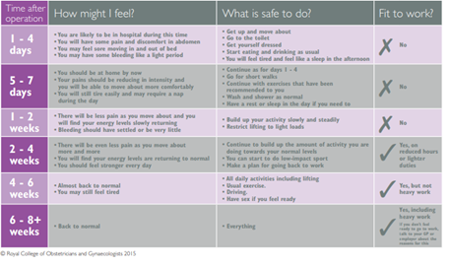
Recovery tracker
Making a choice