

Leaflet Details
| Title | Outpatient Hysteroscopy |
| Department | Gynaecology |
| Author(s) | Selva Olley, James Phillips |
| Review Date | December 2021 |
| Next Review | December 2024 |
| Download | A5 Booklet PDF |
| Accessibility Options | Click on the Recite Me button to show our accessibility resources |
Patient Information
Key Points
- Outpatient hysteroscopy (OPH) is a procedure carried out in the outpatient clinic that involves examination of the inside of your uterus (womb) with a thin telescope.
- There are many reasons why you may be referred for OPH, such as to investigate and/or treat abnormal bleeding, to remove a polyp seen on a scan or to remove a coil with missing threads.
- The actual procedure usually takes 10-15 minutes. It can take longer if you are having any additional procedures.
- You may feel pain or discomfort during OPH. It is recommended that you take pain relief 1 hour before the appointment.
- If it is too painful, it is important to let your healthcare professional know as the procedure can be stopped at any time.
- It is important to use contraception or avoid sex between your last period and your appointment.
- You may choose to have the hysteroscopy under general anaesthetic. This will be done on a different day, in an operating theatre, usually as a day case procedure.
- Possible risks with hysteroscopy include pain, feeling faint or sick, bleeding, infection and rarely uterine perforation (damage to the wall of the uterus). The risk of uterine perforation is lower during OPH than during hysteroscopy under general anaesthesia.
What is a Hysteroscopy?
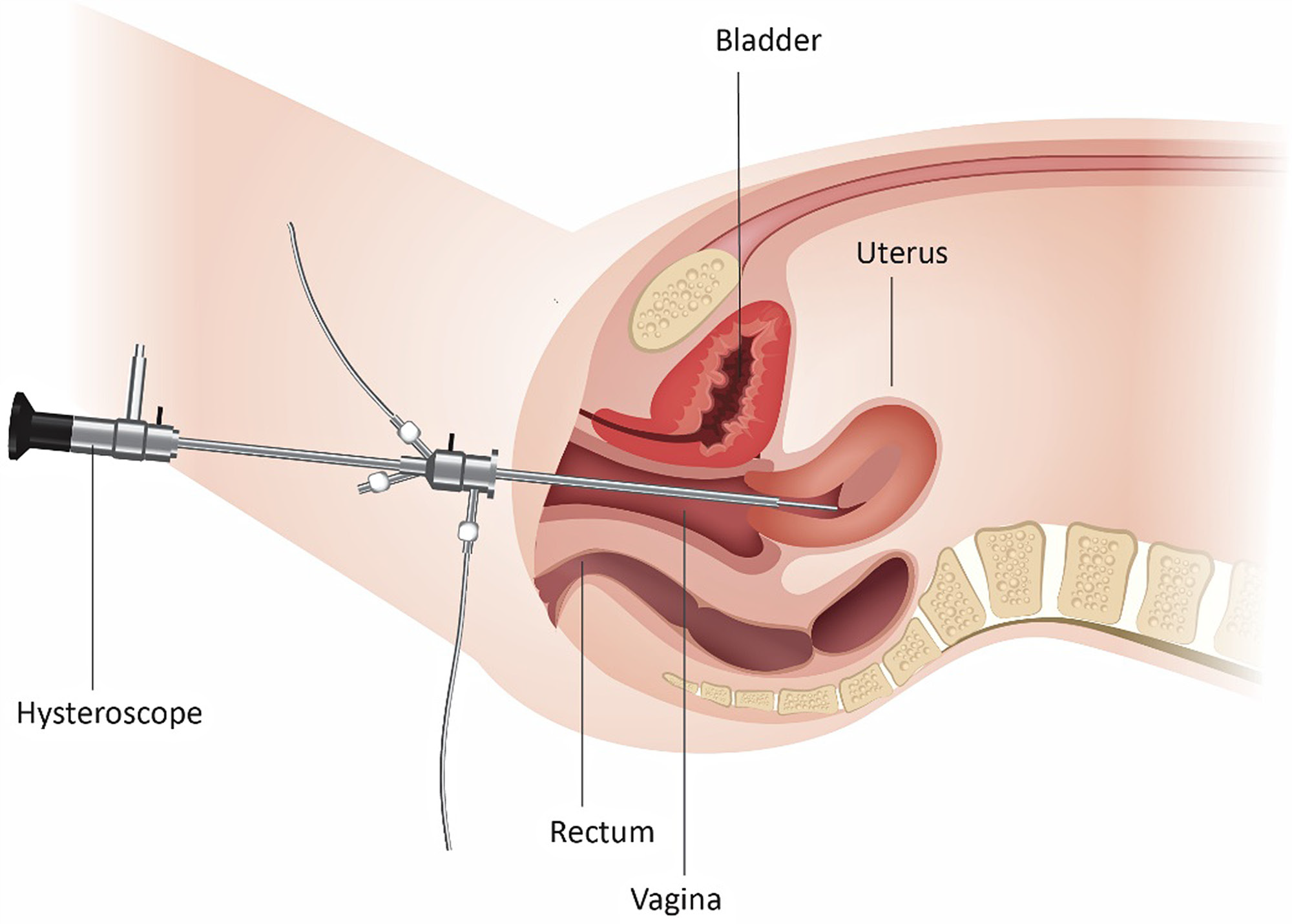
Outpatient hysteroscopy (OPH) is a procedure which allows us to look inside the womb. During the procedure a fine telescope called a hysteroscope is guided through the vagina and neck of the womb into the womb.
Most women are referred to the clinic to investigate unusual bleeding. Often this is caused by noncancerous growths of the lining of the womb like polyps or fibroids. Irregular bleeding or bleeding after the menopause might indicate that there are pre-cancerous or cancerous cells in the lining of the womb. The hysteroscopy examination allows us to identify such abnormalities.
Where will my procedure take place?
It will take place in the Blanche Heriot Unit, which is on the ground floor of the Abbey Wing at St Peter’s Hospital.
We use hysteroscopy in the following situations:
- To investigate bleeding after the menopause
- To investigate an irregular or heavy bleeding pattern
- To investigate fertility problems
- To remove a polyp
- To remove a lost contraceptive coil
- To investigate / remove retained placental tissues post-delivery or miscarriage
Before the procedure
You should eat and drink normally. You do not need to fast before your appointment.
It is recommended that you take pain relief (400 mg of ibuprofen or 1 gram of paracetamol or whatever pain relief you find useful for period pain) 1 hour before your appointment.
Bring a list of any medications that you are taking with you.
The procedure must not be performed if there is any chance that you are pregnant. To avoid this possibility, it is important to use contraception or avoid sex between your last period and your appointment. You may be offered a urine pregnancy test on arrival at your appointment.
We recommend that you ask a friend / relative to accompany you, as it is not advisable to drive home.
Bleeding can obscure the view of the uterine cavity therefore please let us know if you are bleeding heavily or due your period. If the bleeding is light we may still be able to perform the procedure.
Are there alternatives to having outpatient hysteroscopy?
There may be other things to consider when deciding whether OPH is the right choice for you, such as:
- if you faint during your periods because of pain
- if you have experienced severe pain during a previous vaginal examination
- if you have experienced difficult or painful cervical smears
- if you have had any previous traumatic experience that might make the procedure difficult for you
- if you do not wish to have this examination when awake.
You may choose to have your hysteroscopy with either a general or spinal anaesthetic. This will be done in an operating theatre, usually as a day-case procedure. The risks and complications are lower when hysteroscopy is done as an outpatient procedure rather than under anaesthesia. If you would prefer the procedure performed under general anaesthesia please let us know before hand as we will need to make you a different appointment (you can call 01932 722050).
You may choose not to have a hysteroscopy at all, though this may make it more difficult for your healthcare professional to find the cause of your symptoms and to offer the right treatment for you. They may then recommend a scan and a biopsy to find out more information and/or may ask you to come back if your symptoms continue.
What happens during the procedure?
You will see a doctor who will explain how the investigation is done and answer any questions you might have. There will be two or three healthcare professionals in the room and one of them will support you throughout the procedure.
For the procedure you will be positioned on a couch with stirrups supporting both your legs. A tiny telescope is introduced through the vagina and gently into the neck of the womb. Fluid is used to help see the inner lining of your uterus and you will feel wet as the fluid trickles back out.
During the OPH, your healthcare professional will look inside your uterus on a screen and you can also watch the screen if you choose to. Photographs of the findings inside your uterus are often taken and kept in your healthcare notes.
If no problems are found, the actual procedure will only take about 10–15 minutes. Sometimes, a biopsy (small sample) from the lining of your uterus may be taken and sent to the laboratory for examination. The biopsy can be painful, but the pain should not last long.
If a fibroid or polyp is found, it can sometimes be removed at the same time by using additional instruments. You may be offered a local anaesthetic to make you more comfortable, particularly if a wider hysteroscope is to be used (you may hear this referred to as ‘Myosure’). It may be necessary to come back for another appointment for a polyp to be removed using Myosure.
Will any other procedures take place?
No other procedures will take place without your consent. Some women will have an appointment in the outpatient hysteroscopy clinic to have a contraceptive coil (eg Mirena) removed or inserted. Some women with heavy or painful periods, or those on HRT, may be asked if they would like to have a Mirena coil inserted on the day to help control their symptoms. You may wish to think about this before your appointment and further information can be found here: https://www.nhs.uk/contraception/methods-of-contraception/ius-hormonal-coil/
What are the possible risks with outpatient hysteroscopy?
Pain during or after OPH is usually mild and similar to period pain. Simple pain relief medications can help. On occasion, women may experience severe pain.
Feeling or being sick or fainting can affect a small number of women. However, these symptoms usually settle quickly. Let your healthcare professional know if you are feeling unwell during or straight after the procedure.
Bleeding is usually very mild and is lighter than a period, settling within a few days. It is recommended that you use sanitary towels, not tampons. If the bleeding does not settle and gets worse, contact your healthcare professional or nearest emergency department.
Infection is uncommon (1 in 400 women). It may appear as a smelly discharge, fever or severe pain in the tummy. If you develop any of these symptoms, contact your healthcare professional urgently.
Failed / unsuccessful OPH occurs if it is not possible to pass the hysteroscope inside your uterus. Usually this happens when the cervix is tightly ‘closed’ or scarred. If this happens, your healthcare professional will discuss alternative options with you.
Damage to the wall of the uterus (uterine perforation) - rarely, a small hole is accidentally made in the wall of the uterus. This could also cause damage to nearby tissues. This happens in fewer than 1 in 1000 diagnostic hysteroscopy procedures but is slightly more common if someone has a polyp or fibroid removed at the same time. It may mean that you have to stay in hospital overnight. Usually, nothing more needs to be done, but you may need a further operation to repair the hole.
Will outpatient hysteroscopy hurt?
For most women, OPH is quick and safe, and is carried out with little pain or discomfort. OPH is often done without inserting a speculum, by using a thin telescope (called vaginoscopic OPH) as this is more comfortable.
However, everyone’s experience of pain is different and some women will find the procedure very painful. If it is too painful for you, let your healthcare professional know as the procedure can be stopped at any time if you wish.
Your healthcare professional may offer a local anaesthetic injection into your cervix. This will require using a speculum to see your cervix and your healthcare professional will discuss this with you.
Entonox (‘gas and air’) can also be used to help with your pain. In this situation, you may be advised to wait a bit longer in the hospital for recovery before you can drive.
If you feel anxious about the procedure, you should talk to your healthcare professional before your appointment.
How long does the visit take?
The actual procedure may only take 10-15 minutes. If polyps or small fibroids are removed at the same time, this may take a bit longer. You can rest in the outpatient clinic’s recovery area for as long as you need (usually about 20 minutes).
How will I feel afterwards?
You may get some period-like pain for 1-2 days. You may also have some spotting or fresh (bright red) bleeding that may last up to 1 week.
Most women feel able to go back to their normal activities on the same day. You can shower as normal. Normal physical activity and sex can be resumed when any bleeding and discomfort has settled.
If needed, you can take pain relief such as 400 mg of ibuprofen every 8 hours or 1 gram of paracetamol every 4 hours, or your usual period pain tablets.
If your pain is not controlled with the above medication, you should contact your healthcare professional or nearest emergency department.
How do I get the results?
In most cases your doctor will be in a position to discuss the findings with you immediately after the test. If a biopsy has been taken, or a polyp removed, the doctor will either write to you with the results or you will be sent an appointment to be seen in the outpatient clinic.
If you have not received your results within 4 weeks, please contact the Gynaecology Administration Team on 01932 722050.
About intimate examinations
The nature of gynaecological and obstetric care means that intimate examinations are often necessary. We understand that for some people, particularly those who may have anxiety or who have experienced trauma, physical or sexual abuse, such examinations can be very difficult. If you feel uncomfortable, anxious or distressed at any time before, during, or after an examination, please let your healthcare professionals know. If you find this difficult to talk about, you may communicate your feelings in writing. Your healthcare professionals are there to help and they can offer alternative options and support for you. Remember that you can always ask them to stop at any time and that you are entitled to ask for a chaperone to be present. You can also bring a friend or relative if you wish.
Additional information
Should you have any further questions or problems relating to your procedure, please do not hesitate to contact the Gynaecology Administration Team on 01932 722050.
Acknowledgements
Adapted from: Royal College of Obstetricians and Gynaecologists. ‘Outpatient hysteroscopy’ Patient Information Leaflet. London: RCOG; December 2018, with the permission of the Royal College of Obstetricians and Gynaecologists.


