

Leaflet Details
| Title | Removal of Polyp / Fibroid Using MyoSure Device |
| Department | Gynaecology |
| Author(s) | Dr. Diana Yakubovich, Mr. J. Choudhry |
| Review Date | March 2024 |
| Next Review | March 2027 |
| Download | A5 Booklet PDF |
| Accessibility Options | Click on the Recite Me button to show our accessibility resources |
Patient Information
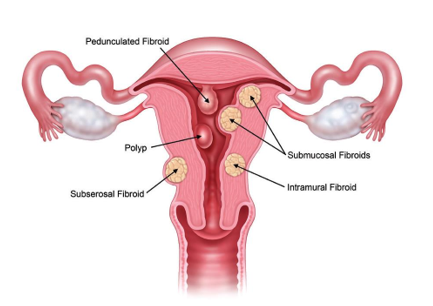
What are Polyps and Fibroids?
Polyps are small protrusions of tissue that grow from the lining of the womb (endometrium). A very small number of polyps (about 5%) can have cancer or pre-cancer cells, hence complete removal is recommended.
Fibroids are non-cancerous tissue growths in the muscle wall of the womb.
Polyps and fibroids are a common cause of abnormal uterine bleeding.
Fibroid types and locations
What is the MyoSure procedure?
This is a procedure performed using a small telescope (hysteroscope) with a camera and light attached to it which is passed through the neck of your womb (cervix) to the inside of your womb (uterus). This enables visualisation as well as removal of polyps and fibroids growing inside the womb cavity using the MyoSure device.
Can MyoSure be used for anything else?
Myosure may also be used for removal of pregnancy tissue within the womb. This may be necessary if you have already had unsuccessful surgical removal of pregnancy tissue called surgical management of miscarriage and your clinician has recommended removal of pregnancy tissue under direct vision (using the hysteroscope) to reduce the chance of leaving pregnancy tissue in the womb. You will need to sign an additional consent form authorizing us to send the specimen to the laboratory for examination. We will contact you if the histology (pregnancy tissue) result is abnormal or inconclusive. If you are Rhesus negative, we will recommend you receive Anti D within 72 hours of the procedure.
What are the benefits?
MyoSure procedure is a safe and quick way of removing polyps and fibroids growing inside the womb cavity. This does not require any cuts in the skin. This is done in the outpatient setting without the need for general anaesthesia. This is particularly useful for women who have a high risk for general anaesthesia.
Recovery following the procedure is quick and most women will be able to go home shortly after the procedure. This minimises the risk of hospital acquired infection. The procedure aims to treat heavy periods, bleeding in between periods or postmenopausal bleeding associated with polyps / fibroids while keeping the womb intact.
The overall effectiveness for reducing heavy bleeding caused by polyps or fibroids is greater than 90%.
What are the risks?
Overall Myosure procedure is extremely safe with an overall complication rate of less than 1%, however, as with all surgical procedures there are some associated risks as:
- Pain, discomfort
- Bleeding
- Infection
- Perforation of the uterus (making a hole in the womb) 1/100
- Damage to internal organs (1-2/1000)
Should perforation of the womb occur, you may require to stay overnight in the hospital for observation. In very rare cases we may recommend either a laparoscopy (keyhole surgery) or a laparotomy (a larger cut in the abdomen) under general anaesthesia to inspect and repair any damage to internal organs such as bowel, bladder and blood vessels.
What are the risks of not having the procedure?
- Your abnormal bleeding may continue.
- There is a small chance (5%) that the fibroid / polyp will contain pre-cancer or cancer changes that may not be diagnosed if they are not removed.
- You may be referred back to the hospital by your doctor for investigation of your persistent abnormal or unscheduled bleeding.
Is there any alternative treatment?
- MyoSure is the only technique used in outpatient by our department to remove fibroids and polyps in the womb cavity.
- An alternative procedure is a Transcervical Resection of Fibroid or Polyp (TCRF / TCRP) but this involves having a general anaesthesia. Please discuss with your gynaecologist if this is something you would prefer to have.
What should I do before the procedure?
You can eat and drink as usual but avoid a heavy meal.
Please take the following medication 1 hour before the procedure:
- 1 gram of paracetamol, AND
- 400mg ibuprofen unless you have any medical reason(s) to avoid these medications).
If you are taking any blood-thinning medication, you would be advised to stop them prior to the procedure by your Gynaecologist. Please ask if this is not clearly communicated.
If you are in the reproductive age group, you should avoid unprotected intercourse between your last period and your appointment.
What happens during the procedure?
Before the procedure begins you will meet the team looking after you that day. The team will consist of a clinician (gynaecologist), a nurse and a healthcare assistant. The clinician will go through your personal medical history with you and then explain the procedure and any associated risks. You will be requested to sign a consent form. You will have an opportunity to ask questions before proceeding.
For the procedure you will be positioned on a couch with stirrups supporting both your legs. Depending on the circumstance, we may recommend the use of a local anaesthetic. This will involve inserting a speculum (the same instrument used during a smear test) into the vagina before injecting a local anaesthetic into the cervix. Usually, four injections are required, and they can cause a sharp sting.
Once you are ready, the hysteroscope will be inserted using saline fluid into the vagina and through the neck of the womb (cervix) into the womb cavity. Fluid will be introduced to distend the womb (it is normal to feel water coming out). This will allow visualization of the inside of the womb and the image will be displayed on a screen next to you. The MyoSure device will then be used to gently remove the polyp / fibroid (you may hear a whirring noise from the machine). Any specimen removed will be sent to the laboratory for examination as routine practice.
What can I expect during the procedure?
During the procedure, you may feel some cramps, similar to period pain. This can be minimized if you take painkillers beforehand, however, if you have any concerns, you will be able to immediately inform the team looking after you.
Entonox (Gas and Air) is available if you wish to use it.
What can I expect after the procedure?
Following the procedure, you will be able to go home as soon as you feel ready and carry on with normal activities. Please organize for someone to drive you home as you may sometimes feel lightheaded soon after the procedure.
Occasionally you may experience mild discomfort for 24-48 hours afterwards which is usually helped by taking Paracetamol or Ibuprofen. You may have some temporary mild vaginal bleeding / discharge afterwards and until this has stopped it is advisable to refrain from using tampons, having sexual intercourse, or going swimming.
When should I seek medical advice?
If you experience any of the below symptoms following the procedure, please contact your doctor or attend the Emergency Department at St Peter`s Hospital.
- Abdominal pain that increases in severity and is not relieved by paracetamol, ibuprofen, or other prescribed pain killer medicine,
- Excessive vaginal bleeding where you are soaking a sanitary pad every 1-2 hours,
- High temperature or fever and chills,
- Bowel or bladder problems,
- A greenish vaginal discharge (reddish, brownish, yellowish is normal),
- Feeling generally very unwell.
Follow up
We will write to you and your GP by letter with the results of the laboratory findings, usually within a few weeks.
Occasionally you will be asked to return to the hospital for a review with your consultant.
You can get further information and advice from
RCOG, Royal College of Obstetrician and Gynaecology:
https://www.rcog.org.uk/for-the-public/browse-our-patient-information/outpatient-hysteroscopy/
Hologic, GYN surgical solution:
https://gynsurgicalsolutions.com/hcp/resources/patient-marketing/
NHS website:
https://www.nhs.uk/tests-and-treatments/hysteroscopy/


