

Leaflet Details
| Title | TCRF (Transcervical Resection of Fibroids) |
| Department | Gynaecology |
| Author(s) | Miss Ngozi Izuwah-Njoku / Dr. Diana Yakubovich |
| Review Date | March 2022 |
| Next Review | March 2025 |
| Download | A5 Booklet PDF |
| Accessibility Options | Click on the Recite Me button to show our accessibility resources |
Patient Information
Introduction
TCRF is a procedure in which the fibroids protruding into the lining of the womb (uterus) are removed or shaved off to make the womb lining as normal as possible (also called resection) using a wire loop. The operation is performed using a hysteroscope, an instrument like a telescope which allows the surgeon to see the inside the womb. Special instruments can then be passed along the hysteroscope so that surgical procedures can be carried out. When the hysteroscope carries a wire loop it is called a resectoscope. Myosure, a device with an integrated device can also be used for resection.
Fibroids are non-cancerous growths of the smooth muscle that makes up the muscle layer of the womb.
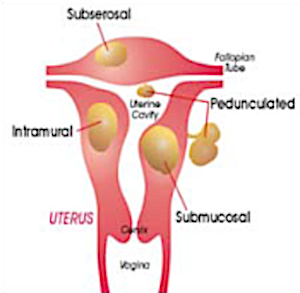
There are various types of fibroids and some women may have a combination of the various types.
- Serosal
- Intramural
- Submucous
The fibroids that are usually treated by TCRF are submucosal fibroids.
Polyps which don’t contain a muscle layer unlike fibroids may also be removed with a resectoscope or myosure.
Procedure
The aim of the operation is to shave off the fibroids or polyps occupying the lining of the womb. This helps make the lining of the womb more normal thereby reducing heavy periods. In the weeks leading up to the surgery, doctors may prescribe drugs to "thin" the lining of the womb. These are usually called Gonadotrophin Releasing Hormones (GnRH) antagonist but please note this is not always necessary.
Once asleep, your legs are placed in stirrups. An internal examination will be done and the cervix will be opened gradually. The surgeon may choose to perform a hysteroscopy first prior to using a resectoscope to ensure a TCRF is necessary. If you have already had outpatient hysteroscopy, this may not be necessary. A watery solution will be used to expand the womb so the doctor can see inside the womb more clearly.
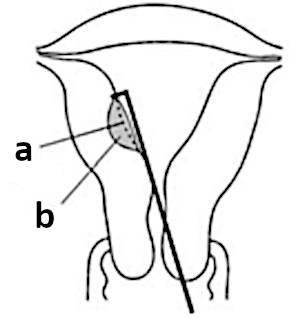
After checking for any possible problems, the fibroid which occupies the lining of the womb will be systematically removed. TCRF usually involves no incisions, stitches, drains or bladder catheters. Sometimes a balloon catheter may be left inside the womb for a few hours if there is significant bleeding during the operation.
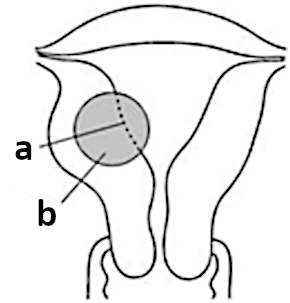
a) Level of normal myometrium
b) Fibroid
Complications
- There is a chance of perforating the womb during a TCRF. Should this happen, there is a risk of damage to any of the other internal organs. If damage to other organ/s is suspected, a laparoscopy (camera through belly button) or laparotomy (open cut on your belly) is usually necessary. The TCRF may have to be postponed for a few months to allow everything to heal back. You will be kept for observation.
- Excessive absorption of the fluid used to distend the womb, leading to a fluid overload in the body.
- Heavy bleeding which may be managed by giving drugs or placing a special balloon in the womb. Rarely, a blood transfusion may be needed if you bleed very heavily.
- Infection. Please present to your doctor if you notice any smelly discharge, fever or chills as this may be due to an infection. You may be prescribed antibiotics.
- Recurrence of fibroids and other rare complications e.g. clots in the legs or chest (DVT/PE).
What happens after the surgery?
It is important that you rest for a few days after the procedure. There will be some vaginal bleeding but this normally becomes light within 24 - 48 hours. The vaginal bleeding will gradually change (usually within 10 days) to discharge which may continue for several weeks to a month. Some women experience crampy lower abdominal discomfort. Simple over the counter painkillers like paracetamol and ibuprofen (if not allergic) can be helpful.
Sometimes the procedure will need to be repeated if the fibroid has been very large and could only be partially removed. A two-stage surgery may reduce some of the risks like a fluid overload which increases with longer operating time. A fibroid that is partially in the muscle of the womb (Intramural) may encroach on the lining once the projecting part is cut. A second stage surgery to remove the remnant of the fibroid may be necessary.
Discharge home
You may be discharged home the same day, if not, then the following day.
We usually expect you to purchase your own painkillers which you can use as required. We may occasionally prescribe stronger pain killers e.g. codeine pain killers.
You should return to normal activities after 7 days
Do not do any exercise for 3-4 weeks.
To reduce the risk of infection, do not put anything into the vagina for 2 weeks e.g. tampons. Don’t have sexual intercourse until the bleeding has completely stopped.
Avoid baths or swimming for 2 weeks or until the bleeding stops.
Following discharge, please contact your GP if you develop symptoms like high temperature, smelly discharge or attend A & E if you feel extremely unwell.
Useful Telephone Numbers
Day Surgery Unit, Ashford Hospital: 01784 884127
Kingfisher Ward: 01932 722380
Ashford Hospital: 01784 884488
St. Peter’s Hospital: 01932 872000
References
https://www.nhs.uk/conditions/fibroids/
Recommendations, management of HMB from:
Overview | Heavy menstrual bleeding: assessment and management | Guidance | NICE
https://www.nice.org.uk/guidance/ng88


