

Leaflet Details
| Title | Pressure Area Care |
| Department | Harms Free Care / Tissue Viability |
| Author(s) | Bibiana Baumgart |
| Review Date | July 2023 |
| Next Review | July 2025 |
| Download | A4 Handout PDF / A5 Booklet PDF |
| Accessibility Options | Click on the Recite Me button to show our accessibility resources |
Patient Information
What are pressure ulcers?
Pressure ulcers (formerly known as bed sores) are areas of skin which have become damaged due to sitting or lying for long periods of time without moving. Constant pressure against the skin reduces the blood supply to that area and the skin becomes damaged. They can also be caused by a medical device such as a catheter or oxygen mask pressing onto the skin.
Where are pressure ulcers found?
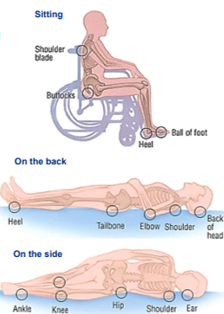
The most vulnerable places for pressure ulcers are over bony prominences like buttocks, elbows, heels, hips, ankles, shoulders, base of the spine and the back of the head.
Pressure ulcers caused by a medical device can develop anywhere on the body.
Who is at risk of developing pressure ulcers?
Pressure ulcers can occur at any age but the following can make them more likely to form:
- increased age - older people are more likely to have mobility problems and skin that's more easily damaged through dehydration and other factors
- being confined to bed or a chair with illness or after surgery
- inability to move some or all of the body (paralysis)
- urinary incontinence and bowel incontinence
- a poor diet
- loss of feeling or sensation
- medical conditions that affect blood supply, make skin more fragile or cause movement problems - such as diabetes, peripheral arterial disease, kidney failure, heart failure, multiple sclerosis (MS) and Parkinson's disease
Preventing pressure ulcers
Each patient’s risk of developing a pressure ulcer is assessed on admission to the hospital. If you already have a pressure ulcer or are assessed as at risk of developing pressure ulcers, a regular process of monitoring will begin which will continue throughout your stay. This will include checking your skin (with your permission) and reassessing your level of risk.
The hospital foam mattresses are designed for patients with a high level of risk. However, depending on the level of risk, it may be necessary for you to be nursed on a special air mattress and / or seat cushion to reduce pressure.
You can help prevent pressure ulcers by
- Regularly changing your position at least every 2 hours whether you are in bed or in a chair. Healthcare staff will assist you if you are unable to reposition yourself
- Inspecting your skin for any signs of redness and telling the nurse if you see any
- If you have darker skin tones this may appear as a purple area and telling the nurse if you see any
- Tell the nursing staff if you have any areas of skin which are painful or sore
- Wash and dry your skin carefully and apply moisturisers
- Eat a well balance diet and drink plenty of fluids to reduce the risk of skin breakdown
Treatment
Treatment of pressure ulcers can be more difficult when a patient has underlying health issues. The care offered will be coordinated by a variety of healthcare professionals who make up a multi-disciplinary team (MDT). This may include Nursing staff, Doctors, Tissue Viability Nurse Specialist, Physiotherapist, Occupational Therapist, Dietitians.
A patient with a more severe pressure ulcer will be referred to a Tissue Viability Nurse (TVN) who will advise the MDT on the treatment and management of the patient’s needs.
If you have a pressure ulcer, we may need to take a photograph of it. Your permission will always be asked in advance. The photograph will be retained in your medical records.
Further Information
Useful websites for general information regarding pressure area management are:
- https://www.nhs.uk/conditions/pressure-sores/
- https://thehealthinnovationnetwork.co.uk/programmes/patient-safety/wound-care/national-wound-care-strategy-programme/
- https://epuap.org/


