Induction of Labour: You have been provided with this booklet because either you, your midwife or your consultant have highlighted that you may benefit from more information around induction of labour.
Leaflet Details
| Title | Induction of Labour |
| Department | Matenity |
| Author(s) | Victoria Kirbell |
| Review Date | January 2025 |
| Next Review | January 2028 |
| Download | A5 Booklet PDF |
| Accessibility Options | Click on the Recite Me button to show our accessibility resources |
Patient Information
Introduction
You have been provided with this booklet because either you, your midwife or your consultant have highlighted that you may benefit from more information around induction of labour.
This may be because of personal choice, a concern or risk factor in your current pregnancy or medical history or due to events that occurred in a previous pregnancy and birth. This booklet contains information to help you decide if an induction of labour is the right decision for you and your baby.
This booklet also explains what happens when your labour is being induced and has a lot of tips to help you have a successful labour and birth.
Induction of labour checklist
This induction of labour checklist has been designed to ensure that you are being provided with all the information you may need to help you make a decision.
Please use this during your appointment to help guide your discussion or refer to it following an offer of induction of labour to highlight any areas that you wish to return to with your midwife or consultant.
- Have you been given verbal and written information that makes sense to you?
- Do you understand the reason you are being offered an induction of labour and the intended benefits of this? (see links below)
- You were given alternative options should you choose to not have an induction?
- You understand the risks associated with induction of labour?
Have you had a discussion around these key points:
- When, where and how induction could be carried out
- Process and methods of induction
- Arrangements for support and pain relief
- Expected length of stay in hospital and potential for delays
- Induction may not be successful and what your options are
- Optimising your induction of labour experience
- You have been offered a membrane sweep (if appropriate)
- You have been given the time to discuss your previous labour and birth if you wish
- You have been given the opportunity to explore your wishes for birth
- You have been given time to think about your decision
Have you read?
There are useful maternity information leaflets provided by Ashford and St Peters Hospital that may be relevant to you. They can be found on your Badgernotes app / website:
https://www.badgernotes.net/Register/Login
If you feel there is anything additional you may like, always ask your Midwife or Doctor.
Antenatal education
Our midwives run free antenatal classes which can booked for when you are around 34 weeks into your pregnancy. These classes include weekly online induction of labour information classes led by the team at Ashford and St Peter’s Hospitals NHS Foundation Trust. Please scan this QR code to view and book for free on Eventbrite.

Why has induction of labour been recommended to me?
It is important to understand the reason you have been recommended induction of labour. These circumstances will be individual to you, below are some examples of reasons we would recommend induction:
- Preventing Pregnancy Complications: Induction may help to avoid certain complications that can arise from prolonged pregnancies or maternal health conditions. This can be crucial for both the mother and baby's health.
- Post-term Pregnancy: Induction is often recommended when a pregnancy extends beyond 41-42 weeks, as the risk of complications (such as placental insufficiency or stillbirth) increases with time.
- Pre-eclampsia: For mothers with pre-eclampsia (high blood pressure), early induction can prevent severe complications like seizures, stroke, or organ damage.
- Gestational Diabetes: Inducing labour in cases of poorly controlled gestational diabetes can reduce the risk of complications such as macrosomia (an overly large baby), which can lead to difficult deliveries or birth injuries.
- Ruptured Membranes: If the waters break but labour does not start on its own, inducing labour can reduce the risk of infection for both the mother and baby.
- Intrauterine Growth Restriction (IUGR): When the baby is not growing as well as expected inside the womb, induction may be recommended to deliver the baby safely and prevent complications.
Making decisions about your care
When you need to decide about the care you receive, the law says that your doctor or midwife should give you all the information you feel you need to help you make the right choice for you. This is called ‘informed consent’.
Doctors and midwives should use factual information, and they should not be pushing you towards any particular decision. If you feel that you do not have enough information, always ask the doctor or midwife to go through it again or to send you some leaflets / weblinks for you to go through in your own time. If this does happen you can talk to another midwife, ask to speak with a manager or the Patient Advice and Liaison Service (PALS) to help advocate for you.
Risks should be provided in a way that you understand, usually with some statistics as well. If you are told that a risk will be doubled for you or increases, you can ask for the figures to support this.
When considering your options, think ...
|
|
B - What are the Benefits? R - What are the Risks? A - What are the Alternatives? I - What does your Intuition or Instinct tell you? N - What if you do Nothing? S - Would you like a Second opinion? |

It is not okay to feel pressured into making a decision
Saying no is always an option, your Midwife or Doctor will work with you to create a personalised care plan to accommodate your wishes and support you. They can also refer you to the Birth Options Clinic, run by a Consultant Midwife, if your wishes fall outside of usual recommendations.
You can decide to delay, decline or stop an induction at any point. The Midwife or Doctor caring for you will discuss with you what implications there may be in delaying, declining or stopping your induction, but your decision will be respected. Should you not wish to be induced your midwife or doctor will discuss this with you and may make some recommendations for monitoring both you and your baby's wellbeing. This may include checking your baby's heartbeat with a monitor and may involve an ultrasound scan to check the placenta function and the water around the baby. How often you may be invited to come to the hospital will be dependent on individual circumstances and the midwife or doctor will discuss this with you.
Benefits and risks of induction
Benefits
- It can relieve medical conditions that could worsen if pregnancy continues.
- Having a date booked in can help you feel more prepared.
- It can reduce the risk of stillbirth, although optimal timing for this is unclear.
- For women and birthing people 42+ weeks, it can reduce the chance of C-section compared with expectant management.
Risks
- Increased risk of assisted birth (forceps and ventouse) and the associated higher risk of third / fourth degree tears.
- Increased risk of C-section compared to spontaneous labour (one in four induced labours result in C-section).
- It can sometimes restrict choice of birthplace and use of a birthing pool
- Can be more painful than spontaneous labour, increased chance of having an epidural.
- There is a need at each step for a vaginal examination, which can be uncomfortable or triggering for some women and birthing people.
- The length of your hospital stay can be longer - average 3.5 days.
Settings for induction
Outpatient
- Induction process started in hospital and continued at home in the initial stage
- If labour starts, you can birth in the Abbey Birth Centre - subject to individual plan
- Reason e.g. post-dates, maternal age, Symphysis Pubis Dysfunction (SPD), baby small / large for dates with normal dopplers and liquor volume, maternal request
Inpatient
- Induction process started and continued in hospital
- Takes place on Joan Booker Ward or Labour Ward
- Indicated when monitoring of mother or baby is recommended during the induction process and plan to birth on Labour ward. E.g. Vaginal Birth After Caesarean section (VBAC), medicated diabetes/hypertension or fetal growth restriction
Helpful statistics
|
Approximately 31% of labours are induced nationally and 38.4% of labours are induced at Ashford and St Peter’s. Induction of labour may be offered when:
|
Table: Gestational age at which labour started, as a proportion of labours which started spontaneously
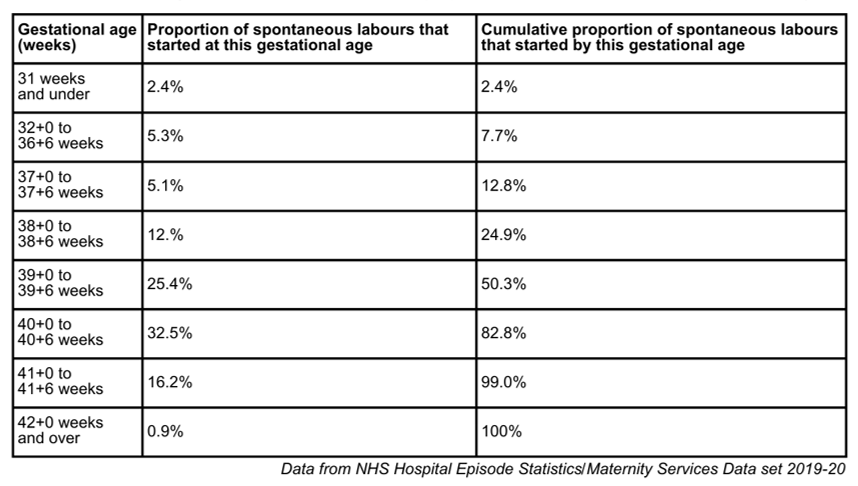
Some risks associated with a pregnancy continuing beyond 41+0 weeks may increase over time and these include:
- increased likelihood of caesarean birth
- increased likelihood of the baby needing admission to a neonatal intensive care unit
- increased likelihood of stillbirth and neonatal death.
|
The National Institute for Clinical Evidence (NICE) updated their guidance in 2021 to recommend that women and birthing people are now offered the opportunity to have their labour induced at 41 weeks for post-dates management. This was previously recommended between 41 weeks and 3 days of pregnancy to 42 weeks of pregnancy. The below table explains the difference in outcomes between induction at 41 weeks and 42 weeks. |
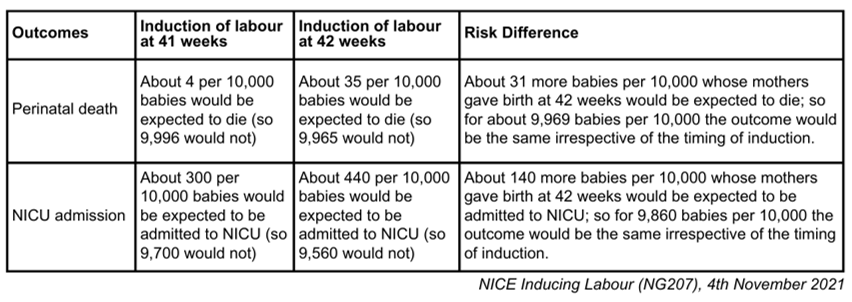
Induction of labour from 41+0 weeks may reduce these risks and for this reason Ashford and St Peter’s Hospitals is now offering induction of labour when you are around seven days over your due date. Evidence suggests that there is no difference in the following outcomes between induction at 41 weeks or 42 weeks:
- Caesarean birth
- Instrumental vaginal birth
- Unassisted vaginal birth
- Meconium aspiration syndrome (MAS)
- Hypoxic-ischaemic encephalopathy (HIE) Maternal death
Induction of labour - what happens?
Induction is a staged approach that can be started medically (hormones) or mechanically.
MedicalUsing hormones including prostaglandins and oxytocin
|
MechanicalUsing tools to dilate the cervix or break the waters
|
Membrane sweep
In the week before the induction is booked, you may be offered/can request a membrane sweep.
What: A midwife or doctor inserts one or two fingers into the cervix and uses a continuous circular sweeping motion to free the membranes (bag of waters) from the lower part of the uterus.
Where: It can be performed at home, during an antenatal appointment at your midwife clinic or in hospital.
When: Will be offered from 39 weeks, although possibly earlier if agreed with a doctor when an early induction is booked.
Propess
What: A vaginal pessary, like a tampon with a flat strip containing prostaglandins. It is inserted with the strip tucked behind the cervix and the string hanging outside the vagina. It stays in up to 24 hours, releasing the hormones to soften and efface the cervix, until labour starts, or dilation is enough to perform an Artificial Rupture of Membranes (ARM).
Where: In Maternity Day Assessment (outpatient) or on Joan Booker Ward (inpatient).
Who: For those who have a firm, long, 0-2cm dilated cervix.
Prostin
What: A syringe containing Prostaglandin gel is inserted vaginally and squeezed around the cervix. If labour doesn’t start after the first dose, a second dose can be given. It aims to soften and open the cervix for labour to commence or to dilate the cervix enough for an Artificial Rupture of Membrane (ARM) to be performed.
Where: On Joan Booker Ward or Labour Ward.
When: After Propess has been tried or when the cervix has started to soften already.
Dilapan
What: Cervical dilating rods. Four to five of these osmotic dilators - made of hydrogel - are inserted vaginally. Whilst in situ, it absorbs fluid within the cervical canal, leading them to increase in size. This helps to open the cervix and release natural prostaglandins. They are removed after 12-24 hours.
Where: Maternity Day Assessment or Joan Booker Ward.
Who: You will not be eligible for this if you have a current urinary tract infection (not including Group B Strep).
Balloon
What: Cervical Ripening Balloon Catheter. One balloon sits inside the cervix, the other outside the cervix. They are both filled with saline fluid to inflate, and the end of the catheter is taped to the inside of your leg. The balloon stays in for about 24 hours, where it rubs against the cervix as you move, aiming to dilate it and stimulate natural prostaglandins to release.
Where: Inserted on Labour Ward by a doctor or senior midwife, then stay on Joan Booker Ward.
Who: E.g. growth-restricted baby, previous uterine or abdominal surgery including c-section.
Artificial rupture of membranes
What: An ARM or breaking the waters. During a vaginal examination, the midwife passes a plastic tool with a small hook on one end (amnihook) through the cervix to make a hole in the amniotic sac, releasing the amniotic fluid. This encourages your baby's head to come down closer to the cervix to apply pressure.
Where: Carried out on Labour Ward (with one-to-one care).
When: Can only be performed if the cervix has begun to dilate. May also be used if labour progress has stalled when membranes are still intact.
Oxytocin drip
What: An intravenous infusion of synthetic oxytocin. Started at a low dose and reviewed every 30 minutes to be increased, dependant on fetal wellbeing and the frequency of your contractions.
Where: On Labour Ward.
When: Following rupture of membranes when there has been no cervical progress or there are too few contractions.
What to expect on the day of your induction
Your midwife or doctor will have given you a date for your induction of labour. Depending on your circumstances you may be offered an induction as an outpatient in our day assessment unit (DAU) or an inpatient on Joan Booker ward (antenatal / postnatal ward). If you have an inpatient induction booked you should call the Joan Booker ward Antenatal Bay at 10.30am on the morning of your induction by calling 01932 722378 to confirm your admission time.
Outpatient
Contact the Call a Midwife line on 0300 123 5473 if you are having an outpatient induction and have any of the following:
|
Inpatient
|
Why might my induction be postponed or delayed?
Midwives and doctors understand that when your induction of labour is either postponed in the first place or delayed whilst you are in hospital, that you may be very upset, disappointed or frightened. Please be assured that the safety of you and your baby is paramount, and a delay may be the safest option. Your induction of labour may be postponed if:
- The workload on Labour Ward means there is no midwife available to care for you at the time and provide safe care.
- The midwives and doctors must prioritise mothers and babies for induction of labour, and another mother/birthing person may have a greater need at the time than you due to their clinical risks.
Should you have any concerns please in the first instance raise these with the Matron, Senior Midwife, or Manager on duty.
What if the induction process is unsuccessful?
The process of induction of labour may not work. Research suggests that labour may not begin for approximately 1 in 20 women and birthing people. If this happens, the midwife and doctor caring for you will discuss the following options with you:
- Offering a rest period if clinically appropriate and then re-assessing
- Waiting for labour to start by itself (expectant management)
- Further attempts to induce labour (as outlined above)
- Caesarean birth
Are there any alternatives to induction of labour?
There is limited evidence about the usefulness of complementary therapies and reflexology to start labour in a healthy pregnancy, but there is some evidence to suggest that acupuncture may improve cervical ripening. Hypnosis and acupressure are not supported as effective methods of IOL according to the available evidence.
If you intend to use complementary therapies to encourage labour to start, it is wise to wait until at least 37 weeks of pregnancy and reduce the risk of a preterm birth.
All treatments have benefits and disadvantages; do not use any treatment that you do not understand fully and have not consulted with a professional trained in their use. The following are likely to be more beneficial than harmful:
- Methods to encourage release of natural prostaglandins; nipple and/or clitoral stimulation, sexual intercourse.
- Stimulation of the muscles of the uterus; acupuncture on points which link to the uterus, raspberry leaf tea.
Hand expressing colostrumCollect your breastmilk for when baby comes. Nipple stimulation increases oxytocin to help with contractions. Ask your midwife for syringes. Scan the QR code for more information. |
|

Pain management options
There are many different pain management options that are available to you during your induction and labour. Your midwife or doctor will be able to guide you and answer any questions you may have with each option.
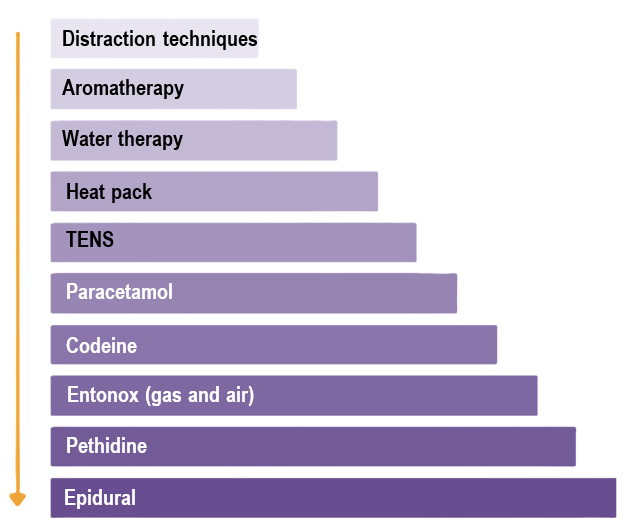
Water therapy - a bath, shower or birth pool is soothing, relaxes the joints and muscles giving a weightless feel.
A TENS machine - is a device that uses mild electrical impulses to help manage pain by stimulating nerves and reducing discomfort during childbirth.
Codeine - a stronger tablet that can be taken with paracetamol to ease pain.
Pethidine - an opioid injection into the thigh giving you a drowsy effect.
Epidural - a spinal anaesthetic performed by an anaesthetist on Labour Ward, numbing you from the waist down.
Optimising your induction of labour
Movement
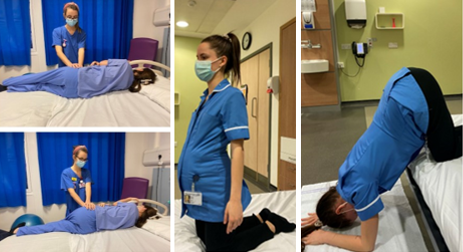
Walks, swaying/dancing, pelvic tilt, walking sideways up and down stairs, supported lunge with foot on a chair, massages and side-lying can all help.
Biomechanics techniques can also help – ask your midwife for a birth ball - read on to find our more or watch our videos on the Abbey Birth Centre Instagram using this QR code.

Relax
Different relaxation techniques can help optimise your induction of labour. This could include nipple stimulation, a warm bath, massage, aromatherapy, dim lighting and calm music.
Rest
Resting in all fours position, forward position (lean over chair, bed, ball or sit backwards on toilet), side lying, or using a birth ball for gentle rotation or a figure of eight can all optimise your induction of labour.
Snack and hydration
Eating light meals and snacks will help to keep your energy up. You should ensure you drink to avoid thirst and make sure to empty your bladder regularly.
Entertainment
Bringing a book, iPad or even a crossword puzzle can help to keep you occupied whilst you’re waiting. Please be considerate of those around you and use headphones if possible.
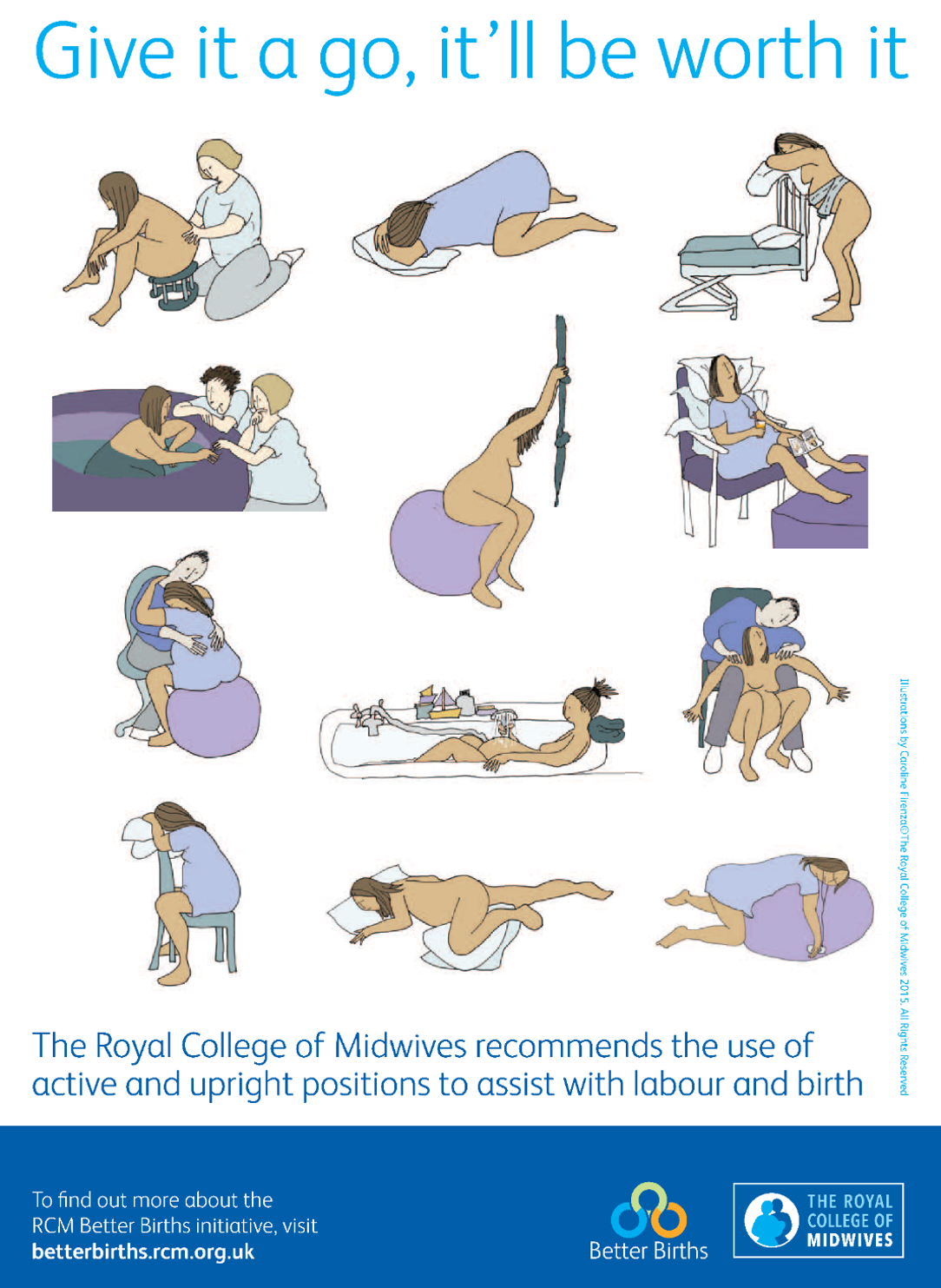
Biomechanics
Here you will find a QR code link to a biomechanics leaflet demonstrating some antenatal techniques to encourage a comfortable pregnancy and an easier labour. The positions can be done from 28 weeks of pregnancy onwards. Important: please ensure you have someone to assist you with these techniques at home.
Information leafletsPlease scan the QR code to access our full range of information leaflets, including the biomechanics leaflet - or visit |
|