

In this section, we have leaflets for the Urology department. Please only read the materials on the advice of your clinician.
The Recite Me accessibility tools can be used if you need assistance.
Acute Urinary Retention
This leaflet addresses some questions you may have about acute urinary retention and what to expect on going home.
Flow Rate and Post-Void Residual
A flow rate is a test that is used to show how quickly and effectively you empty your bladder. The post-void residual is the volume of urine left in your bladder after you have passed urine. Both tests are useful to help identify the cause of your bladder/ urinary symptoms and will help your doctor know what will be the best treatment.
Male LUTS - Your Clinic Appointment
We will be doing a range of tests during this appointment. You may have to spend 3-4 hours in the clinic depending upon the diagnostic tests you may need.
Please read through all the information to understand about the diagnostic tests. Please complete all questionnaires prior to your appointment.
My Urinary Catheter Passport
This passport is for you and/or anyone else involved in the care of your catheter. The information in it will help you care for your catheter at home and ensure your carer / healthcare professional has the right information.
Please take your urinary catheter passport with you to all your healthcare appointments, on hospital admissions and when you travel.
Nocturia (waking up at night to pass urine) - patient information leaflet, questionnaires and sleep-frequency-volume chart
Nocturia is a common condition. It is estimated that as many as a half of fifty-year-olds wake up at least once to pass urine during the night and one in five wakes up two or more times
Waking up twice or more per night to urinate is associated with the significant impairment in the quality of sleep, reduced quality of life and impaired daytime functioning. Nocturia more than twice a night is associated with an increased risk of depression, cardiovascular disease and even early death. Frequent trips to the toilet at night put patients at the risk of falls and fractures.
Transperineal Prostate Biopsy Under General Anaesthetic
Prostate glands are only found in men and are about the size of a walnut. Your prostate gland is located just below your bladder and in front of your rectum (back passage). Its function is to produce white fluid that becomes part of your semen.
A transperineal biopsy is a diagnostic procedure intended to take samples of tissue (biopsies) from your prostate gland under a short general anaesthetic. The samples are then sent to a histopathologist, who examines the samples under the microscope for abnormal cells, such as prostate cancer. Due to the special way in which the specimens are prepared, the results take around two to three weeks to come back.
Transperineal Prostate Biopsy Under Local Anaesthetic
This biopsy procedure is used by clinicians to look for cancer in the prostate gland.
Your clinician may perform this biopsy because a rectal examination, MRI prostate scan, or blood test looking at your PSA (prostate specific antigen) level have shown abnormal results.
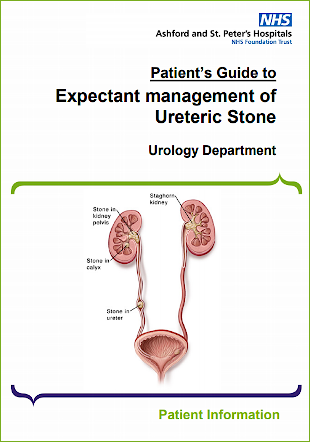
Ureteric Colic
If you were discharged after being told you had a stone in your ureter, this leaflet answers a few questions many people ask about this condition.
External Leaflets
- BAUS: ESWL
- BAUS: Flexible Cystoscopy
- Biolitec: TULA® Procedure


