

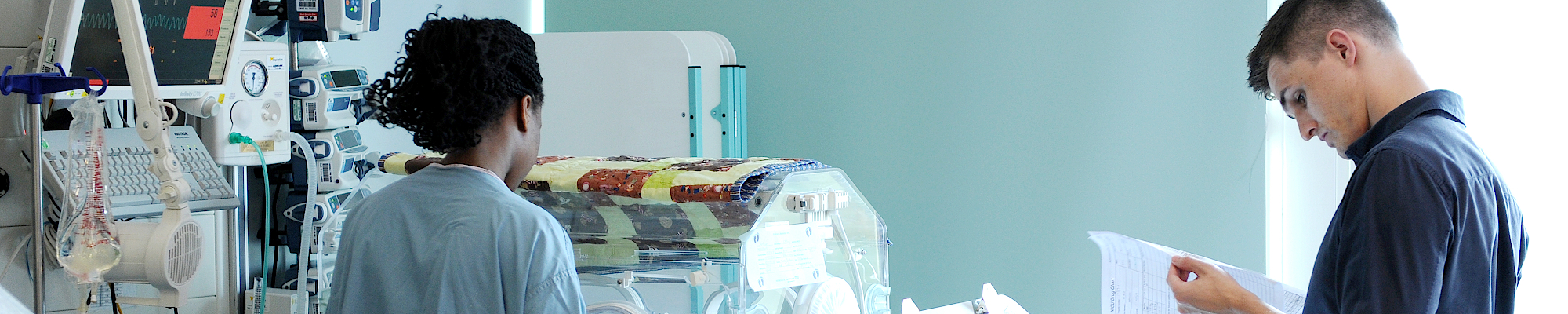
Research is an important part of what we do on the Neonatal Intensive Care Unit (NICU) to improve treatment and care for babies now and in the future.
Parents have the opportunity to give consent for their babies to participate in clinical research trials that are appropriate for them.
Over the past few years we have taken part in several large NHS funded studies such as:
- PIPS - use of probiotics
- SIFT - speed of feeding
- ELFIN - lactoferrin use to prevent infection
- ROPP - prevention of Retinopathy of Prematurity
- Pedal - the long term follow up of ROPP
Dr. Peter Reynolds, who is the lead clinician for neonatal research, designed and published a study on High Flow Delivery room stabilisation which has led to a change in our practice to make this a more gentle experience for babies.
Dr Vennila Ponnusamy has been researching biomarkers in brain injured babies hoping to target treatment for these babies in the future.
We have dedicated research nurses, Nicky Holland and Karen Wells, working on the neonatal unit as part of the wider Research and Development Team at Ashford and St Peter's.
Both are experienced neonatal nurses who have worked with the NICU team for many years
If you would like more infromation about research at Ashford and St Peter's hospital, or to read about some of the research, please follow the links below:
- Research at Ashford and St Peter's
- Stabilisation of premature infants in the delivery room with nasal high flow
- Supporting "Baby Friendly": A quality improvement initiative for the management of transitional neonatal hypoglycaemia
- Admission to NICU in air is more likely if nasal High Flow is used for stabilisation in preterm babies compared to face mask CPAP
eNewborn International Neonatal Research Database
eNewborn is a collection of information (a database) about babies from neonatal units around the world. All the information on eNewborn is “de-identified”; this means it is impossible to find out about or identify individual babies from the database. The headquarters of eNewborn is in the UK at Imperial College London, one of the top ten universities in the world.
eNewborn is approved by the UK National Research Ethics Service (reference 26/LO/0444) for use under data protection and research legislation to improve newborn care. Imperial College London is the data controller for eNewborn and is responsible for looking after the information in the database and using it properly. Everyone involved at Imperial College will keep your data safe and secure and follow all privacy rules. No one will be able to work out who you or your baby are from any outputs of the database.
This information sheet tells you about eNewborn, an international neonatal research database. In eNewborn we use information from your baby’s medical records.
Quality Measures
- Grand Round – our consultant neonatologists do a joint weekly ward round to ensure that care is consistent and quality is maintained.
- We have weekly team meetings where key people involved with the care of babies on the neonatal unit meet such as ultrsound, Xray and microbiologist round.
- We have a psychosocial meeting with the multidisciplinary team with NCOT, safeguarding midwife, consultants and nurses. The results are then sent to named health visitors.
- We have a developmental care ward round each week.
- Neonatal assembly where small issues are discussed and then measures implemented to improve standards
- We regularly audit the quality of our care locally, and have 100% participation in the National Neonatal Audits to ensure quality standards are maintained.
- We monitor and comply with relevant national standards.
- An active program of simulation training involving nurses, midwives and doctors from different teams to help prepare staff for emergencies and unexpected events.
- Every year we produce a Unit Report (including mortality and morbidity figures for the unit) and a Governance Report.
- All new nurses partcipate in a preceptorship programme ensuring high standard of education and nursing skills.
- vWe encourage all nurses to further their development offering them specifc courses such as the Neonatal Intensive Care Course


