

De Quervain’s Tenosynovitis
De Quervain’s Tenosynovitis is a painful condition that affects the tendons on the thumb side of the wrist. It happens when these tendons become irritated and swollen, making it uncomfortable to move the thumb or wrist.
Tendons are strong cords of tissue that connect muscles to bones and help the body move. The thumb tendons travel through a small tunnel called a tendon sheath. When these tendons are overused, the sheath can become inflamed and thickened, making it harder for the tendons to glide smoothly. This causes pain, tenderness, and sometimes swelling near the base of the thumb.
Simple Wrist Anatomy
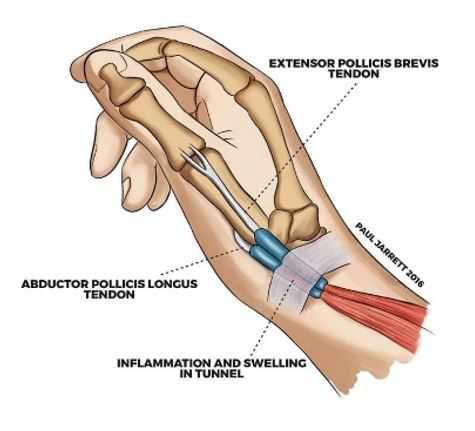
This condition affects two main thumb tendons in an area of the wrist called the first dorsal compartment:
- Abductor Pollicis Longus (APL) - moves the thumb away from the hand
- Extensor Pollicis Brevis (EPB) - helps straighten the thumb
These tendons pass through a narrow tunnel on the thumb side of the wrist near a small bony point called the radial styloid. If the tendons or their sheath become swollen, the space becomes tight and movement can become painful.
Common symptoms
People with De Quervain’s Tenosynovitis may notice:
- Pain on the thumb side of the wrist
- Tenderness or swelling near the base of the thumb
- Pain when gripping, twisting, or lifting
- Difficulty moving the thumb or wrist
- Pain that may travel up the forearm
What causes it?
The condition is usually linked to repetitive movements of the thumb and wrist, especially gripping or twisting actions.
Examples include:
- Gardening
- Racquet sports
- Repetitive work tasks like working with tools
- Lifting a baby
Who is most likely to get it?
- Most common in women aged 30–55
- Often seen in new parents or carers
- Can affect anyone who uses their thumb and wrist repeatedly
Important:
Although it can be painful, De Quervain’s Tenosynovitis is not dangerous. In many cases it improves with rest, activity changes, splinting, and gradual progressive exercise.
Treatment
Treatment will depend on how long you have had symptoms and the activities you do each day. In most cases, treatment focuses on reducing irritation in the tendons and gradually improving strength and movement.
A combination of rest, simple treatments, and splinting is often recommended.
1. Anti-inflammatory treatments
Reducing inflammation around the tendons can help ease pain. This may include:
- Anti-inflammatory gels applied to the painful area
- Ice placed on the thumb side of the wrist for short periods
- Oral non-steroidal anti-inflammatory medications (NSAIDs) if recommended by a pharmacist or doctor
These treatments can help settle irritation in the tendon sheath
2. Activity changes and modifications
Certain movements can aggravate symptoms, especially those involving repeated gripping, twisting, or lifting.
- Try to avoid or reduce activities that increase pain in the early stages.
- As symptoms improve, you can gradually return to these movements.
- A clinician or physiotherapist may guide you through progressive strengthening exercises to help the tendons tolerate activity again.
3. Splints
A splint can help support the thumb and reduce strain on the tendons.
- Splints can usually be purchased online or from a local pharmacy.
- They hold the thumb and wrist in a neutral position, allowing the tendons to rest.
- They are often worn during painful flare-ups or during activities that trigger symptoms.
- Splints are to be worn 24/7, aside from showering, for six weeks and then weaned away slowly thereafter; meaning they are only to be worn for strenuous activity or night as needed from the six weeks mark.
Most people improve with conservative treatment, although recovery can take several weeks depending on the severity of symptoms and activity levels.
4. Hand Therapy
If your pain has settled but your hand has not regained normal function, you may be referred for hand therapy.
A hand therapist can use a range of treatments, including specific exercises, to help improve the gliding of the tendons within the tendon sheath. The aim is to restore the tendons’ ability to tolerate load and support a safe return to normal daily activities.
Most people improve with conservative treatment, although recovery can take several weeks depending on the severity of symptoms and activity levels.
Exercises
Between three-six weeks of wearing a splint, we aim to begin isometrics exercise. These exercises should be challenging, but not painful. If pushing with 100% effort feels too painful, tailor back to 50%; if symptoms persist above a 4/10 pain where 10/10 is ready for A&E, reduce effort to 10% or if needed, cease the exercises for 24-48 hours. These exercises can be completed every other day for 2-3 sets of 10 repetitions where each repetitions is held for 5 seconds of resistance.
After six weeks of wearing the splint, aim to progress to resistive exercises. These should be as comfort and pain allows.
If symptoms are not improving
For many people with De Quervain’s Tenosynovitis, symptoms improve with conservative treatment. However, it can take a few weeks before there is any noticeable improvement.
If the treatments described above do not help, other options may be considered.
1. Steroid Injection
A corticosteroid injection may be offered if symptoms are not settling with conservative treatment. This injection is placed around the irritated tendons and can help reduce inflammation and pain. Many people experience significant or rapid pain relief.
As with any injection, there are some potential risks, including:
- Infection
- Tendon weakening
- Nerve irritation or damage
Your clinician will discuss whether this option is suitable for you.
2. Surgery
Surgery is rarely needed but may be considered if other treatments have not improved symptoms. The procedure involves making a small incision at the base of the thumb to release the tight tendon sheath and create more space for the tendons to move freely. It is usually performed under a general anaesthetic, and most people go home on the same day.
Post-operative care
After surgery:
- A dressing is usually applied for the first 48 hours.
- Stitches typically remain in place for around two weeks (unless absorbable sutures are used).
- Gentle exercises are encouraged in the first few days to help restore movement as pain allows.
- Heavy lifting or pulling should be avoided until the stitches have been removed.
Possible risks of surgery
Although surgery is generally successful, there are some potential risks, including:
- Infection
- Ongoing pain
- Nerve irritation or damage
- A prominent scar
- Recurrence of pain or symptoms
Your healthcare professional will discuss these risks with you and help decide on the most appropriate treatment for your situation.


