

What is it?
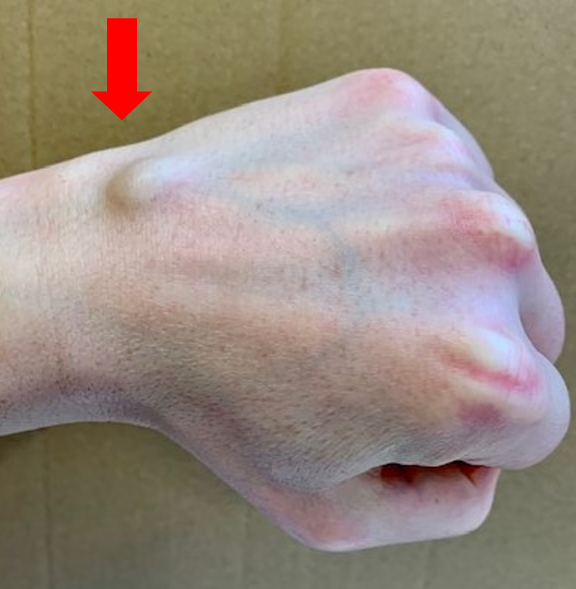
A ganglion cyst is a small fluid filled sac that forms over a joint or sometimes tendon (tissue that connects muscle to bone). Inside of the sac is a thick and sticky jelly-like material called synovial fluid. They can feel soft and spongy to touch or sometimes very firm, almost like a bone.
- Ganglion cysts most commonly occur on the back of the hand at the wrist joint but they can also develop on the palm side of the wrist. When found on the back of the wrist, they often times become more prominent when the wrist is bent. Cysts can also develop on the finger joints where they are called pearl ganglions.
- Ganglions most commonly occur in women with most occurring in people between the ages of 20 and 40 years.
What is the cause?
The cause of ganglion cysts is unknown. The most accepted theory involves a flaw in the joint capsule or tendon sheath that allows the synovial fluid to leak out causing a bulge.
What are the symptoms?
- The ganglion cyst usually appears as a bump that can change in size. They can spontaneously appear and disappear.
- It can be soft or firm to touch and can measure from 1-3 cm in diameter but can grow much larger than this. They don’t move.
- Most ganglion cysts cause some degree of pain. Up to 35% are without symptoms except for appearance.
- If pain is present, it is usually chronic and aching in nature with more sharp pain experienced to loading of the affected joint.
- When the cyst is connected to a tendon, you may feel a sense of weakness in the affected finger.
Treatment
Many cysts can disappear without any treatment at all. We no longer routinely surgically remove cysts as there is a 50% chance they will return. The most common interventional treatment is a needle aspiration which draws the jellylike substance out followed by injecting a bit of steroids (anti-inflammatory).
This procedure can be repeated.


