

What is a mallet finger (thumb) injury?
A mallet finger injury is usually caused when the end joint of a finger is forced to bend forwards suddenly.
Causing the tendon that straightens the tip of the finger to tear or pull away from bone.
Symptoms:
- Inability to straighten the end joint of the finger.
- Pain & swelling may be present.
Treatment:
A splint will be applied to your finger to keep the end joint straight while the tendon heals. Initially, you will be provided with a temporary ‘off the shelf’ splint which will adequately hold your finger straight. However, most patients with this injury will be referred to the Hand Therapy Department for a more bespoke, comfortable splint.
Constant Splinting Phase:
- The splint is worn constantly day & night for a minimum of six to eight weeks; your Consultant or Therapist will advise how long you will need to wear the splint.
- It is very important that the splint is always securely taped or strapped to your finger & that the end joint DOES NOT BEND during this period of splinting. As any movement of the end finger joint will delay healing & may cause a poor outcome.
Take all precautions to keep the splint & finger dry at all times to prevent your skin from becoming very sore.
It is advisable to remove the splint at least once a week to clean your finger & splint, it is much easier if someone assists you with this. Some people may want to do this daily, this is perfectly acceptable. To clean your finger, place the tip of your finger (palm side) lightly on to the tabletop. Remove the tape / straps and carefully remove the splint. Using a Wet Wipe carefully clean your finger while it is resting on the tabletop, dry, then reapply the splint securely. Please ensuring while cleaning your finger you do not allow the end joint to bend as this could cause further damage.
Your Hand Therapist will demonstrate how to fit & remove the splint & clean your finger.
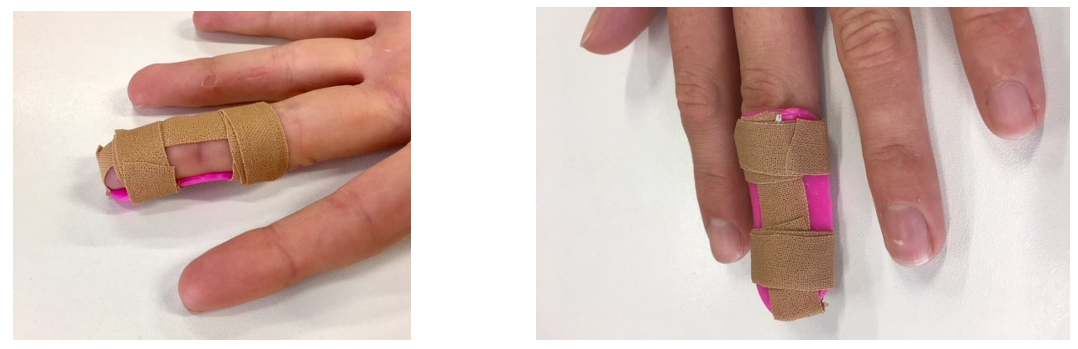
Pictured is the most frequently supplied splint.
Protective splinting phase:
After six or eight weeks your Hand Therapist will check your finger and if the tendon is sufficiently healed you will progress onto a two to four week period of protective splinting. You are still required to wear the splint overnight & during the day, outdoors, at school, at work & during moderate activities. However, it can be removed in a safe environment, also for cleaning your hand & to perform gentle exercises as demonstrated by your Hand Therapist. It takes twelve weeks for the tendon to fully heal. Your finger will feel stiff and movement will improve with the exercises, however please do not be tempted to physically push your finger into a bent position.
Contact your Therapist if your splint causes any of the following problems:
- Increased pain
- Skin irritation/soreness; you think the splint is rubbing
- You think your finger has become more swollen
- If your splint feels loose when swelling reduces
If your hand or fingers turn blue, feel cold, or tingle:
- Check the straps are not too tight
- Loosen the straps and seek medical advice if the symptoms continue.
If problems arise, please contact the Hand Therapy Department to arrange an appointment.
We can only see you if you have been referred by your GP, Consultant or Walk in Centre / A&E. In an emergency, seek medical advice from the above.


